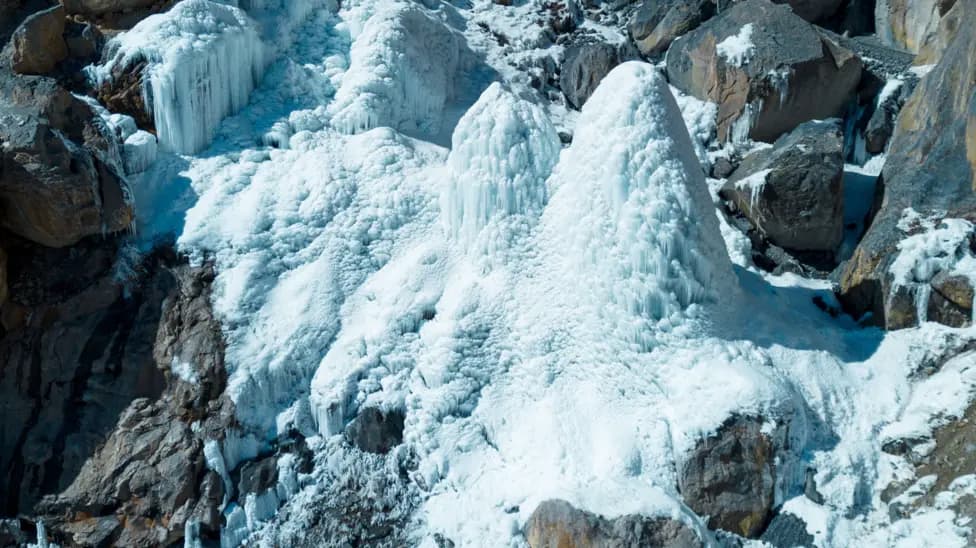
Automated Ice Reservoirs Tackle Water Scarcity in Ladakh, India's Himalayan Villages
Farmers in Ladakh, a contested region in Indian-administered Kashmir, contend with a brutal, single-cultivation season exacerbated by the disappearance of low-altitude glaciers. Gelak Gutme, a 65-year-old farmer in Sakti, recounted losing his entire field last year due to water scarcity. Lobzang Fardod, of a local water management committee, noted the prior reliance on smaller glaciers as "frozen water towers" which have now vanished, leaving a "desert of dry rock". The critical need for early spring water to facilitate planting by May, ahead of the winter, has driven innovation.
Evolution of Ice Reservoir Technology
Earlier efforts in the 2010s involved rudimentary ice stupas, piping mountain water to spray and freeze into large ice towers. However, these proved a "nightmare" to manage. Murtaza Ali, executive engineer in Ladakh's Irrigation and Flood Control Division, highlighted the constant risk of pipe cracking in temperatures below minus 20C, or even minus 30C, requiring constant monitoring by teams of farmers. The previous system also suffered from inefficiency, with continuous water flow causing existing ice to melt on warmer days.
A technological upgrade, the Automated Ice Reservoir (AIR), developed in partnership with Acres of Ice, now offers precise control over ice production. Dr Suryanarayanan Balasubramanian, founder of Acres of Ice, explained that water piped from higher elevations is released as a "massive fountain" from a vertical nozzle. A solar-powered, weatherproof control box, connected to a weather station, monitors environmental conditions and water temperature. If conditions risk freezing within the pipes, the system automatically drains the water, preventing damage. Instead of continuous spraying, AIR applies bursts of mist, allowing each layer to freeze solid before the next application, converting almost all diverted water into ice.
Impact and Future Expansion
The AIR system operates autonomously via a local wireless network, though villagers retain a manual override. Ali reported positive feedback from villagers, indicating groundwater recharge and timely water availability, with a scientific study planned to quantify the impact. In winter 2025, ten AIR projects operated across Ladakh. Balasubramanian aims to significantly multiply the number of ice reservoirs with the current technology. In Sakti, Gutme expressed renewed optimism, stating, "I am a farmer, land is all that I have to survive on... all that I know today is that I have water to grow my crops." The availability of water is seen as crucial to deterring younger generations from migrating to cities.