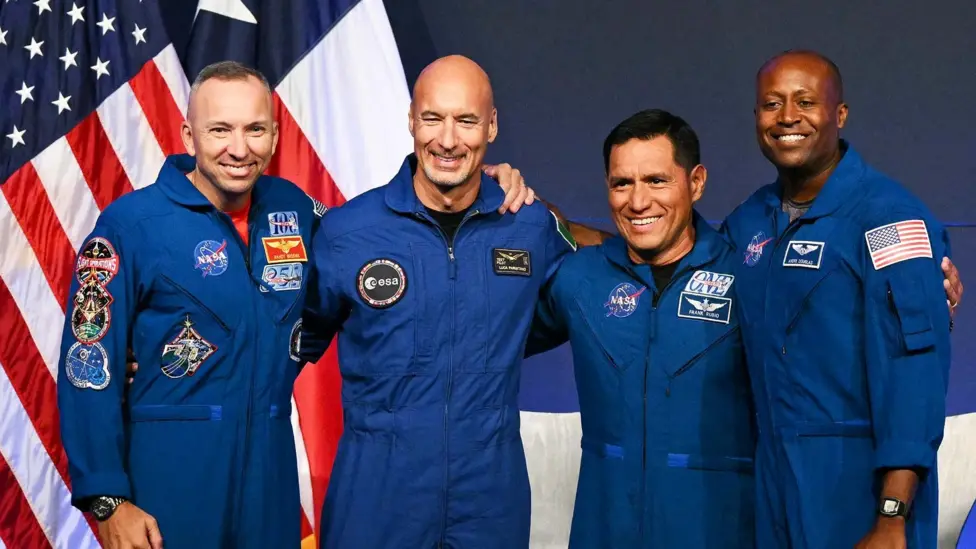
Nasa Names Randy Bresnik to Command Artemis III Mission, Lunar Landing Delayed
Nasa has announced the crew for its forthcoming Artemis III mission. Astronaut Randy Bresnik will serve as mission commander, with Luca Parmitano of the Italian Space Agency as pilot, and Americans Andre Douglas and Frank Rubio as mission specialists. Bob Heintz has been named as a backup crew member.
Originally conceived as the first crewed lunar landing since Apollo 17 in 1972, the Artemis III mission scope has been significantly curtailed. It will now operate solely in low Earth orbit, a trajectory barely beyond the International Space Station, to conduct docking procedures with prototype lunar landers.
This alteration follows delays in the development of Elon Musk’s SpaceX Starship rocket, which is intended to transport astronauts from lunar orbit to the Moon's surface. A Government Accountability Office report in March 2026 noted SpaceX’s “limited progress maturing the technologies needed for in-orbit refuelling and cryogenic propellant storage.” Starship’s substantial mass necessitates in-orbit refuelling, a complex manoeuvre involving a fleet of tanker vehicles that has yet to be demonstrated.
Further complicating Nasa’s lunar ambitions, its other partner, Blue Origin, experienced a New Glenn rocket explosion during an engine test last month. While no injuries were reported, the launch pad sustained extensive damage. Blue Origin lacks alternative launch facilities, meaning repairs could extend over several months, impacting the timeline for its Blue Moon cargo lander and the crewed lander required for Artemis 4.
Nasa Administrator Jared Isaacman described the revised mission as “the most awe-inspiring coordination of heavy-lift rocket launches in history,” despite the absence of a lunar landing. The agency's commitment to supporting Blue Origin’s recovery effort has been stated, though the timeline for repairs remains uncertain.
The revised Artemis schedule optimistically targets Artemis 3 for a demonstration flight in 2027, with a lunar landing for Artemis 4 in early 2028, and Artemis 5 following later that year for base construction. However, independent experts largely view this timeline as ambitious.
Underlying this urgency is a geopolitical imperative, with China aiming for a crewed Moon landing by 2030. A Trump executive order in December 2025 mandated Nasa to return astronauts to the Moon by 2028 and establish initial base elements by 2030, aligning with the end of his potential term.
Dr Simeon Barber, a lunar scientist at the Open University, remarked, “It would not surprise me at all if China gets there first.” Nasa’s margin for error is demonstrably thin, given the unproven refuelling technology for Starship, a key commercial partner’s non-operational launch pad, and the reliance on a sequence of unprecedented technical achievements unfolding perfectly.