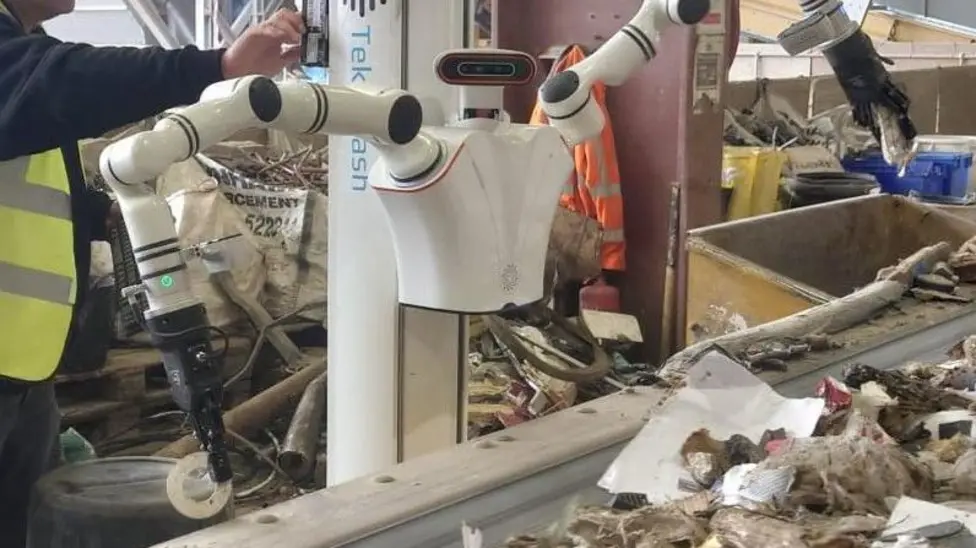
Sharp Group Deploys Alpha Robot for Waste Sorting Amidst 40% Staff Turnover at Rainham Plant
Sharp Group, a family-run skip and waste management firm, is integrating robotics at its Rainham, East London recycling plant to combat a 40% annual staff turnover. The facility, which processes up to 280,000 tonnes of mixed recycling each year, relies on 24 agency workers for its rapid conveyor belts.
The waste sector is characterised by hazardous conditions, with work-related injury and ill-health 45% higher than in other industries, and a fatality rate significantly above the national average. These factors, alongside the inherently unpleasant nature of the work, make staff retention difficult, according to line supervisor Ken Dordoy, who noted, “The belt is moving all the time, you're constantly picking. I go through a lot of pickers because they just aren't up to the job.”
Enter Alpha (Automated Litter Processing Humanoid Assistant), a robot built by RealMan Robotics in China and adapted by British firm TeknTrash Robotics. Alpha is currently being trained to sort waste, with a plant worker wearing a VR headset to record successful picking and sorting movements. TeknTrash founder Al Costa explained that this early-stage training is crucial, as “the market thinks these robots are prêt‑à‑porter, that all you need to do is to plug them to the mains and they will work flawlessly. But they need extensive data in order to be effectively useful.”
Other companies, such as Colorado-based AMP and California's Glacier, are also advancing automated sorting. AMP uses AI-driven air jets, claiming its robots are “eight or 10 times the pace” of human workers. Glacier, co-founded by Rebecca Hu-Thrams, employs mounted robotic arms and AI, noting the challenge of sorting items ranging from liquid-spraying beer cans to “hand grenades and firearms”.
Despite varying approaches, all firms agree that the human-intensive model is unsustainable. Professor Marian Chertow of Yale University stated, “Robotics coupled with AI-driven vision systems offers the greatest potential for improving material recovery, worker experience, and economic competitiveness in the recycling sector.”
Chelsea Sharp, Sharp Group's finance director, highlighted the robot's appeal: “It will pick all day, 24 hours a day, seven days a week. It's not going to apply for a holiday, it's not going to have a sick day.” She anticipates upskilling existing staff to maintain and oversee the robots, thereby moving them away from the “unappealing”, dirty, noisy, and dangerous environment of manual sorting.