Xi Jinping and Vladimir Putin Project Unity Amidst Unequal China-Russia Partnership
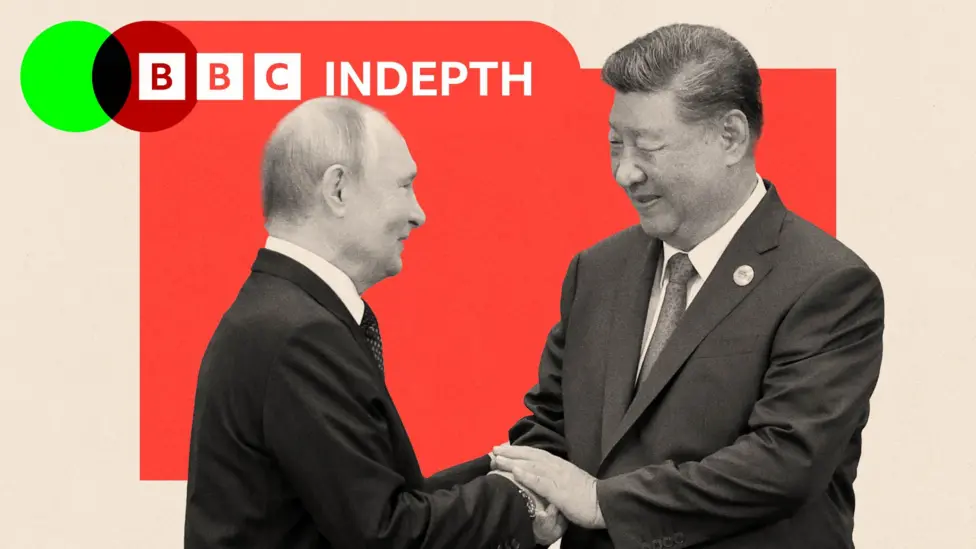
When Chinese President Xi Jinping and Russian President Vladimir Putin met in Beijing last September, their conversation touched upon life extension through organ transplants, a telling exchange for two leaders with a combined 39 years in power.
Unequal Dynamics in a Strategic Partnership
Putin’s upcoming visit to Beijing, coinciding with the 25th anniversary of the Treaty of Good-Neighbourliness and Friendly Cooperation, is expected to be markedly more understated than the lavish reception afforded to US President Donald Trump recently. This subdued approach reflects the increasingly unequal nature of the China-Russia relationship, a dynamic openly acknowledged by analysts.
Alexander Gabuev, director of the Carnegie Russia Eurasia Centre, contends that "Russia is fully in China's pocket, and China can dictate the terms." This imbalance is evident in economic ties: China is Russia's largest trading partner, yet Russia accounts for merely 4% of China's international trade. Years of Western sanctions have progressively pushed Moscow towards greater economic reliance on Beijing, particularly for technology and components essential to its military operations in Ukraine. A recent Bloomberg report indicated Russia is importing over 90% of its sanctioned technology from China, a 10% increase year-on-year.
Despite this, Moscow attempts to assert its status. Dmitry Trenin, president of the Russian International Affairs Council, affirmed that Russia does not wish to be a "vassal state" and must maintain an "equal footing."
Strategic Flexibility and Shared Interests
Marcin Kaczmarski, a lecturer in security studies at the University of Glasgow, notes China's "self-restraint" in dealing with Russia, wary of provoking a backlash from a proud, albeit junior, partner. Russia's continued military engagement in Ukraine, while a liability, also offers Beijing tactical advantages, including opportunities to test military technologies and secure vital energy resources. The proposed Power of Siberia 2 pipeline, set to deliver 50 billion cubic metres of Russian gas to China via Mongolia, underscores this strategic interdependency, offering China energy security amidst global instability.
Bobo Lo, formerly of the Australian Embassy in Moscow, characterises the relationship as a "flexible strategic partnership" rather than a formal alliance, explaining its resilience against Western predictions of collapse. Both nations share a 4,300km border, complementary economies, and a mutual opposition to a US-led global order. Crucially, they refrain from criticising each other over issues like alleged human rights abuses in Xinjiang or the death of Alexei Navalny, fostering an "organic symbiotic relationship" that prioritises pragmatic cooperation over Western-centric moralising.
While both Beijing and Moscow oppose what they perceive as "Western hegemony," their approaches diverge. Russia seeks to construct an entirely new global order, whereas China maintains a more cautious, pragmatic stance, as demonstrated by its measured response to US actions in Iran and its continued willingness to engage with Washington.
Beyond high-level political posturing, people-to-people connections are deepening. Western sanctions and stricter European visa policies have funnelled Russian citizens, students, and businesses towards China, facilitating greater cultural and economic exchange through visa-free travel and increasing adoption of Chinese products. Despite historical scepticism regarding cultural affinity, this growing interconnectedness, driven by geopolitical realities, reinforces the partnership's stability. Analysts suggest the Sino-Russian partnership is too critical to fail, given the lack of viable alternatives for either country.