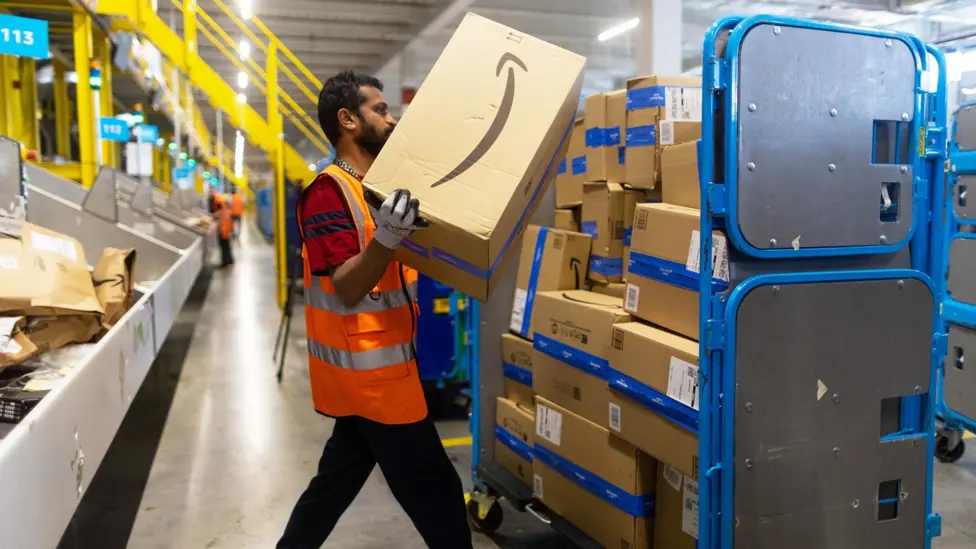
Amazon Dominates Western E-commerce: Unpacking Market Control and Antitrust Challenges
Amazon, the global retail giant, has become the world's largest company by annual sales, overshadowing competitors like Walmart. Launched in 1995 by Jeff Bezos, Amazon's expansive reach encompasses online retail, supermarket chains, streaming services, and its highly profitable Amazon Web Services (AWS) cloud computing division, leading many to question the scarcity of significant Western rivals in e-commerce.
Amazon's Unrivalled Market Share and Strategic Dominance
While competitors exist across Amazon's diverse ventures—Walmart and Target in online retail, Tesco in UK online groceries, and Chinese platforms Temu and Shein for budget goods—none approach Amazon's overall e-commerce market share. In the US, Amazon commands 40.5% of all online retail sales, significantly more than Walmart's 9.2% and eBay's approximately 3%. The UK market mirrors this dominance, with Amazon holding around 30% of online retail sales. Annabelle Gawer, director of the Centre of Digital Economy at the University of Surrey, notes, "Amazon is not an undisputed monopolist in e-commerce, but it is the dominant firm. And the scope of what it sells is unparalleled."
Experts attribute Amazon's formidable position to a confluence of factors. Its 'first-mover' advantage allowed it to rapidly capture market share by revolutionising online shopping with unparalleled convenience and speed. Crucially, shareholders' long-standing willingness to tolerate losses and aggressive reinvestment of profits into business growth—Amazon has never issued a dividend—constrained traditional competitors who faced punitive stock market reactions for similar strategies. Today, Amazon leverages the substantial profits from AWS to subsidise its lower-margin retail operations and fund new ventures.
The company's self-positioning as a technology firm has been pivotal, utilising algorithms, automation, and data to drive efficiency and enhance customer experience. Additionally, Amazon's culture of bold experimentation, exploring diverse areas from cloud computing to healthcare, has contributed to its growth. Two strategic shifts were particularly instrumental: transitioning to an online platform in 2000, allowing third-party sellers to offer goods, created a powerful "network effect" that locked in customers and attracted more sellers. Secondly, the 2005 launch of Amazon Prime in the US (2007 in the UK), offering free and fast delivery for an annual fee, made the platform "very sticky," as noted by Emily West, a professor at the University of Massachusetts Amherst. Prime's expanded bundle of services, including streaming content and Whole Foods discounts, further entrenches membership.
Antitrust Challenges and Future Outlook
Beyond strategic advantages, some argue that Amazon's practices may contravene competition law, impeding the growth of existing rivals and the emergence of new ones. Both the US Federal Trade Commission (FTC) and the state of California have initiated separate antitrust lawsuits against Amazon, scheduled for trial in early 2027. These lawsuits allege unlawful tactics to maintain dominance, with California last month releasing a trove of evidence to support its claims. Amazon denies these allegations and is vigorously defending against the legal action.
A central accusation in the FTC case is that Amazon prevents price competition from smaller marketplaces. It is alleged to penalise sellers by reducing their product visibility or removing their "Buy Box" if they offer lower prices on competitor websites. This alleged practice disincentivises shoppers from seeking lower prices elsewhere, undermining rivals' strategies to attract sellers with reduced fees. Proposed solutions include breaking Amazon into multiple standalone entities, a move some experts view as unlikely, citing the example of Google's avoidance of a similar outcome in its recent competition case.
While an incumbent like Walmart could potentially replicate elements of Amazon's model, the company's next significant threat may not emerge from conventional retail. The rise of generative AI interfaces, such as ChatGPT, which embed e-commerce directly, enabling users to purchase products without leaving the AI platform, presents a new challenge to Amazon's online retail hegemony. Despite its pervasive influence, Harvard Business School professor emeritus David Yoffie concludes, "You aren't necessarily seeing a company that is impossible to compete against."