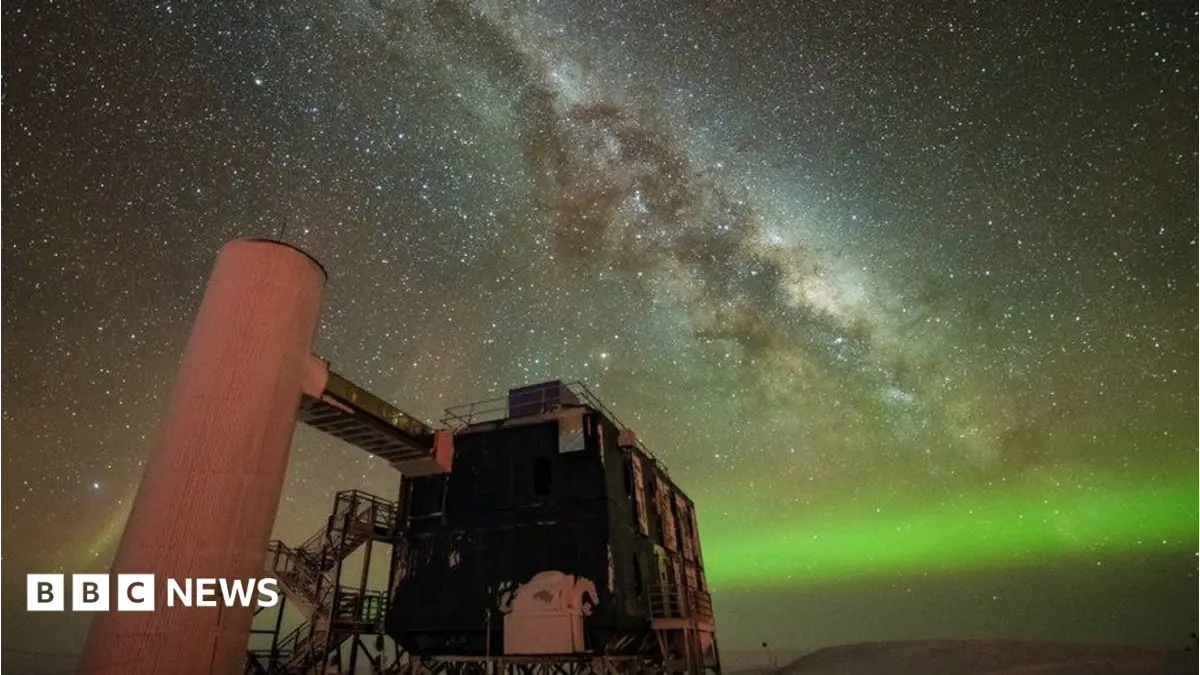
Belgian Physicist Francis Halzen Wins Nobel Prize for Antarctic Neutrino Observatory
Belgian physicist Professor Francis Halzen has been recognised with the Nobel Prize in Physics for his pioneering work on the IceCube Neutrino Observatory. Located at the South Pole, IceCube is a unique telescope designed to detect high-energy neutrinos, often referred to as 'ghost particles' due to their elusive nature.
These neutrinos, which possess no electric charge and negligible mass, interact very weakly with matter, allowing them to travel vast cosmic distances unimpeded. Detecting them provides a distinct window into the most violent astrophysical phenomena, such as exploding stars, gamma-ray bursts, and active galactic nuclei – processes that produce energies far exceeding those achievable in terrestrial laboratories.
Professor Halzen's leadership was instrumental in the conception, construction, and operation of IceCube, an undertaking that involved embedding thousands of optical sensors deep within the Antarctic ice sheet. The observatory functions by observing the faint blue light, known as Cherenkov radiation, emitted when a neutrino collides with an atom within the ice, creating a cascade of secondary charged particles.
The Nobel Committee highlighted the observatory's crucial role in ushering in a new era of neutrino astronomy, allowing scientists to pinpoint the cosmic accelerators responsible for these incredibly energetic particles and offering fresh insights into the fundamental workings of the universe.