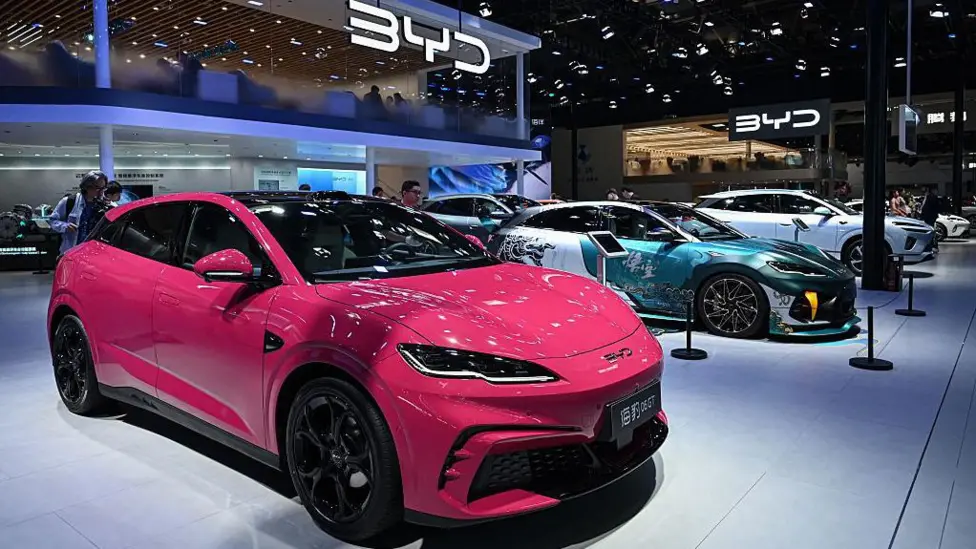
BYD Executive Stella Li Confirms Firm's Success Without Accessing US Car Market
BYD, the Chinese electric vehicle manufacturer, confirms its ability to operate successfully without access to the United States market. The company, which outpaced Tesla in global electric vehicle sales last year, is instead prioritising increased demand across Asia, Europe, and other international regions, including Brazil and the UK.
Stella Li, BYD executive vice president, stated at the Beijing Auto Show that the firm is currently struggling with insufficient production capacity due to high demand, rather than seeking US customers. Li attributed this surge to rising petrol prices, which make the daily savings offered by EVs more attractive to consumers.
BYD is banking on its new 'flash charging' technology to overcome customer reluctance regarding charging speeds, claiming it can add hundreds of kilometres of range in minutes. This innovation is expected to broaden the appeal of their electric vehicles.
Geopolitical Headwinds and Technological Edge
This global expansion occurs against a backdrop of geopolitical tensions. Chinese EV manufacturers face tariffs and stringent regulatory scrutiny in Western markets, notably the US, where concerns over government subsidies, data protection, and national security have been voiced by officials. Despite these hurdles, Li emphasised BYD's growing brand recognition outside the US, particularly within the UK market.
Chinese firms are increasingly competing on technological advancement, moving beyond their previous reliance on price-cutting. Innovation in battery technology, charging infrastructure, and software integration is central to their strategy. Li highlighted BYD's broader industrial footprint, encompassing smartphone components, battery storage, solar panels, and commercial vehicles, describing it as an 'ecosystem'.
The Beijing Auto Show, now the world's largest industry event, showcased over 1,400 vehicles, with Chinese manufacturers taking centre stage. Other firms, such as X-Peng, demonstrated ambitious plans, including humanoid robots later this year and flying cars by 2027. Traditional Western automakers, including Volkswagen, Toyota, and Ford, are increasingly collaborating with Chinese companies, such as BMW partnering with CATL and Volkswagen co-developing EVs with XPeng, to remain competitive.
Domestically, BYD faces significant challenges, with seven consecutive months of declining sales due to aggressive price wars and rapid product cycles that have squeezed profit margins. However, sales in Europe surged by 156% in the first quarter of this year. Li anticipates that such competitive pressure will inevitably lead to consolidation within the industry.