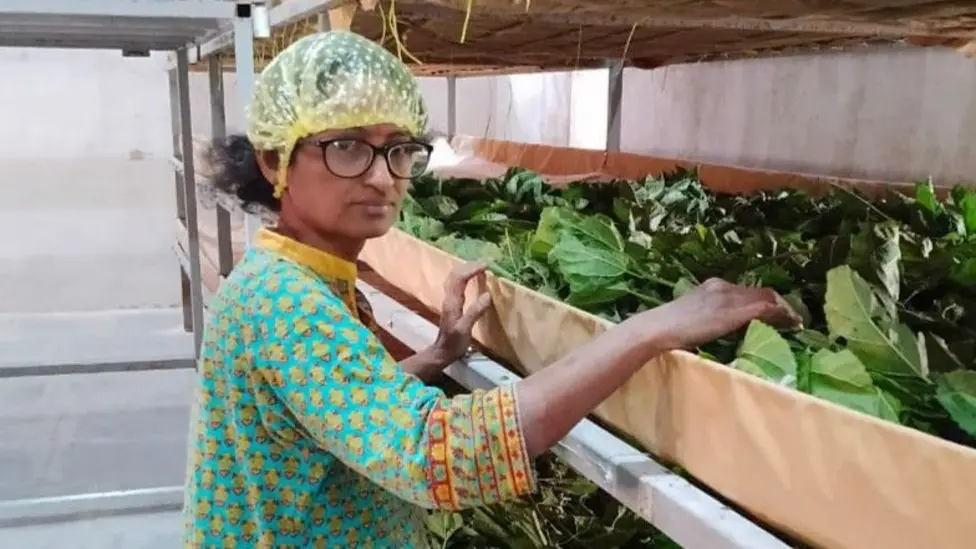
Former Scientist Jolapuram Umamaheswari Drives India's Silk Production, Earning £760 Monthly
Dr. Jolapuram Umamaheswari, a former scientist from Singapore, transitioned to sericulture in Andhra Pradesh six years ago, driven by a desire for self-employment. Her silk farm, despite initial challenges with disease outbreaks and inconsistent yields, now produces ten raw silk crops annually, generating approximately £760 each month.
Umamaheswari describes sericulture as a rare intersection of biology, precision, and business, enabling her to apply her scientific background in a practical setting. Her methodical approach to hygiene, feeding practices, and environmental control has significantly improved cocoon quality and silkworm survival rates.
Technological Integration Boosts Silk Production
The Indian silk industry is undergoing a substantial digital and biotechnological shift. Krishna Tomala, founder of Asho Farms, highlights the integration of advanced technology from silkworm egg production to cocoon rearing. Sensors and automated systems now precisely manage temperature and humidity, crucial for silkworm growth, which can increase a thousandfold in just 25 days.
Asho Farms also employs AI and computer vision to detect early signs of disease in silkworm larvae with over 99% accuracy. This allows for immediate removal of infected worms, preventing widespread contamination of crops.
India, the second-largest global silk producer, boasts all four commercial varieties of silk: Mulberry, Tasar, Eri, and Muga, with Muga silk being unique to the country. The government's Central Silk Board is actively pursuing genome editing in collaboration with international partners, such as Japan, to develop disease-resistant silkworm varieties.
Furthermore, the industry is exploring innovative uses for by-products. For every kilogram of raw silk, approximately two kilograms of dried silkworm pupae, rich in over 50% protein, are produced. These pupae are now being repurposed as feed for poultry and fish.
Industry Concerns and Future Outlook
Satheesh Kannur, who operates a reeling company converting cocoons into raw silk yarn, notes that technology is transforming reeling from a manual craft into a precision-driven industry, supported by solar power for sustainability. However, Kannur expresses concern about the future supply of silk cocoons, fearing that a decline in second-generation farmers and fragmented landholdings could hinder industry growth.
Conversely, the Central Silk Board maintains that while the number of farmers may be decreasing, overall cocoon production is rising due to advancements in rearing techniques, disease control, and scientific support, leading to significantly increased yield per acre.
Umamaheswari, back in Andhra Pradesh, plans to diversify her farm with a cow shed, generating additional income from milk and utilising manure to fertilise her mulberry plants, exemplifying how even small improvements can enhance yield and quality in this rewarding field.