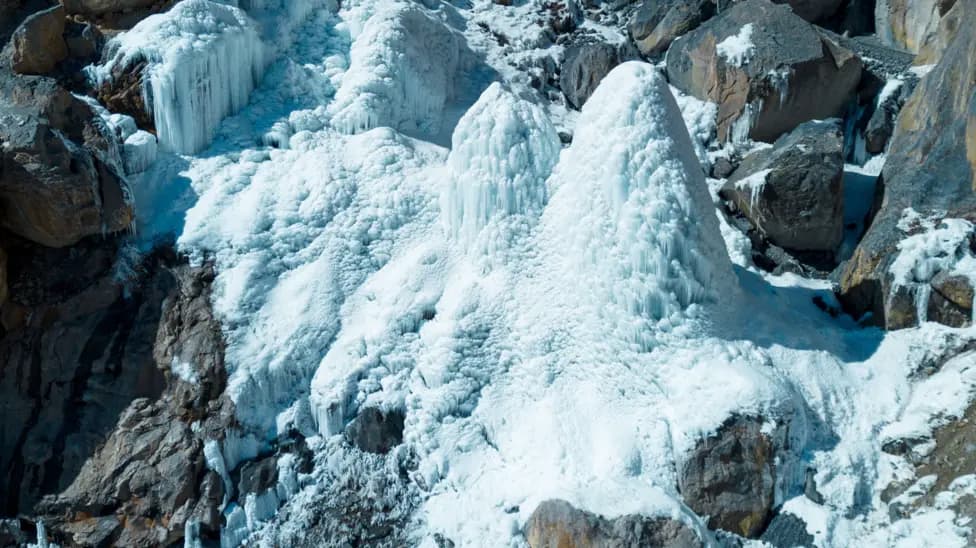
Ladakh Villages Deploy Automated Ice Reservoirs to Secure Vital Early Spring Water
Farmers in Ladakh, an Indian-administered region bordering China and Pakistan, face severe agricultural challenges due to its high altitude, minimal rainfall, and the disappearance of low-altitude glaciers. Gelak Gutme, a 65-year-old farmer in Sakti, explained, "Ladakh has a brutal, single-cultivation season. It is a desert with an extreme climate." Rising temperatures have eliminated the smaller glaciers previously relied upon for spring irrigation, leaving fields to dry out.
Lobzang Fardod, a member of a local water management committee, noted, "For generations, small glaciers sitting right above the valleys acted like frozen water towers, holding onto water all winter and releasing it right when spring farming began. Now that those lower glaciers have completely vanished into a desert of dry rock, there is nothing left at the top to melt." The short mountain summer necessitates planting by May, making reliable early spring water critical.
Automated Ice Reservoirs Combat Water Scarcity
Earlier attempts in the 2010s involved "ice stupas," which piped water from higher elevations to freeze into large ice towers. However, these proved difficult to manage, with pipes prone to cracking in temperatures as low as minus 30C, requiring constant monitoring by teams of farmers. Murtaza Ali, an executive engineer in the Irrigation and Flood Control Division, Ladakh Autonomous Hill Development Council, highlighted the inefficiency of the continuous flow, where warmer days melted already formed ice.
The region has now adopted an upgraded system developed with the private company Acres of Ice. The Automated Ice Reservoir
(AIR) system pipes water down from the mountains, which then shoots from a vertical nozzle. A computer-controlled system, powered by solar panels and a battery, monitors environmental conditions via a weather station. If temperatures drop too quickly or pipe water approaches freezing, the system automatically drains the pipes, preventing damage. This method also creates ice more efficiently by releasing short bursts of mist, allowing each layer to freeze before the next application.
Dr Suryanarayanan Balasubramanian, founder of Acres of Ice, stated that AIR converts almost all diverted water into ice. The system operates autonomously, connected by a local wireless network, though villagers retain manual override capabilities. During the winter of 2025, ten AIR projects were implemented across Ladakh. Ali reported villagers observing "groundwater is getting recharged and spring sources are getting revived. They are getting water in time." Farmer Gutme, now more optimistic, hopes Sakti will install additional AIR systems, noting, "I am a farmer, land is all that I have to survive on. I don't know the technology, all that I know today is that I have water to grow my crops."