Pentagon Email Suggests US May Suspend Spain from NATO Over Iran War Stance
A leaked email originating from the US Pentagon has revealed proposed punitive measures against allies deemed insufficiently supportive of the US-Israel campaign against Iran. The document, first reported on Friday, suggested the US could seek to suspend Spain from NATO for its stance.
Spanish Prime Minister Pedro Sanchez, arriving at an EU leaders' summit in Cyprus, dismissed the reports, stating, "We are fulfilling our obligations toward NATO." Spain has consistently opposed US-Israeli strikes on Iran, deeming them illegal under international law, and denied US forces permission to use joint military bases in Spain for operations against Iran. Furthermore, Spain is the only NATO member to reject the US president's demand for a 5% GDP defence spending increase.
Fellow EU leaders, also NATO members, quickly rallied to Spain's defence. Dutch Prime Minister Rob Jetten affirmed Spain's full membership, adding that European nations were "doing a great deal to strengthen NATO." A senior German official echoed this, asserting, "Spain is a member of NATO. And I see no reason why that should change."
Italian Premier Giorgia Meloni criticised the tensions between Washington and Madrid as "not at all positive." Meloni has also denied the US permission to use the Sigonella airbase in Sicily for military operations against Iran and condemned Donald Trump's derogatory remarks about the Pope as "unacceptable." Trump, in turn, lashed out at Meloni, stating, "She's the one who's unacceptable" and "no longer the same person."
The leaked Pentagon email also hinted at reviewing the US position on the UK's claim to the Falkland Islands, a move linked to British Prime Minister Sir Keir Starmer's initial denial of US requests to use British military bases for Iranian operations. While the UK has since allowed the US to use bases and RAF planes have participated in drone interceptions, Starmer maintains that deeper involvement in the war and the US blockade of Iran's ports are not in the UK's interest.
Experts note there is no provision in NATO treaties to expel a member country, and any action to bar Spain from key civilian or military roles would require unanimous consensus from all NATO members. Camille Grande, former NATO Assistant Secretary General for Defence Investment, described the email as betraying a "fundamental misunderstanding" of NATO's consensus-based nature within the Trump administration.
French President Emmanuel Macron has accused Donald Trump of "hollowing out" NATO through repeated public undermining of the alliance. These public displays of disunity pose a significant threat to Europe's defence, particularly for eastern European nations facing an increasingly aggressive Russia, whose war economy benefits from elevated oil prices exacerbated by the US counter-blockade of Iran's effective blockade of the Strait of Hormuz.
Polish Prime Minister Donald Tusk openly questioned the US's commitment to Article 5 mutual defence. NATO estimates Russia could be ready to attack a member state within three years, with the Dutch military intelligence service, MIVD, assessing Moscow could initiate a regional conflict against NATO within a year of the Ukraine war's conclusion, aiming to politically divide the alliance under threat of nuclear armament.
Further concerns emerged after the US Pentagon informed Estonia it would delay delivery of contracted High Mobility Artillery Rocket Systems (HIMARS) due to its own operational needs in the war with Iran, leaving the Baltic state feeling exposed.
Julianne Smith, former US ambassador to NATO, observed that "punitive measures like removing force posture in Spain seem over-reactive in light of the fact that Allies were never asked to assist the US and Trump has frequently denied that the US actually needed European support." She warned that such actions could "issue another devastating blow to the relationship and cast a long, dark shadow over the upcoming NATO summit in July."
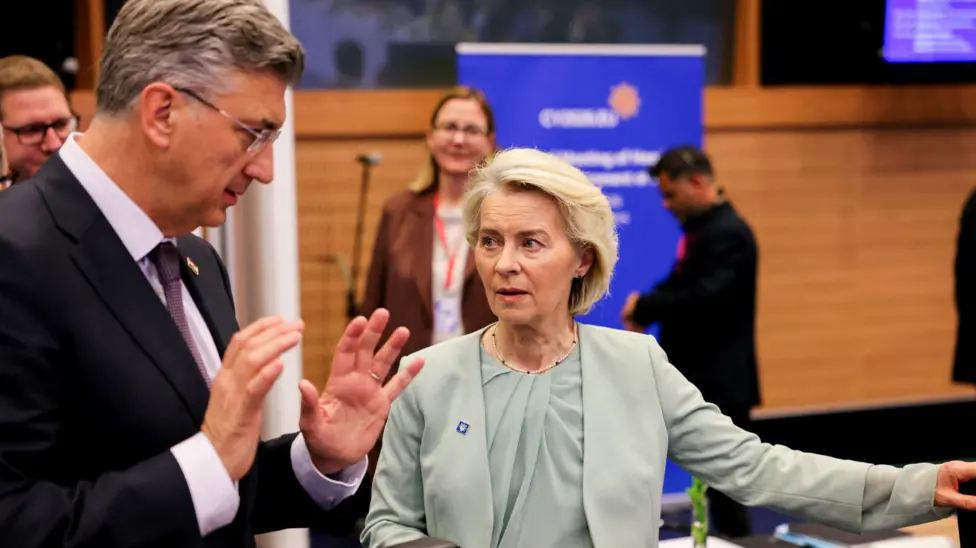
At the Cyprus summit, some European leaders explored the EU's mutual defence article 42.7, questioning its applicability if NATO's Article 5 proved unreliable under a Trump presidency. However, European Commission head Ursula von der Leyen noted the treaty is clear on the "what" of mutual aid but ambiguous on "when, and who does what."
Despite these tensions, many European NATO and EU nations, led by France and the UK, are preparing an international maritime patrol and mine-sweeping initiative for the Strait of Hormuz post-hostilities, an effort seen, in part, as an attempt to placate President Trump.
Former NATO Secretary Jens Stoltenberg cautioned that the alliance's continued existence is not guaranteed, though he argued its survival is in the US interest, providing global military and economic structures that rivals like China and Russia lack. Stoltenberg also pushed back on the notion that Europe has broadly abandoned the US over Iran, noting most allies have provided behind-the-scenes logistical support.
European NATO members consistently reiterate that the alliance is a defensive pact, not designed to formally endorse offensive actions, viewing the US-Israeli attacks on Iran as a war of choice. European governments favour diplomacy and sanctions over unilateral military action.