Trump Announces Sunday US-Iran Deal Signing, Tehran Expresses Caution on Timeline
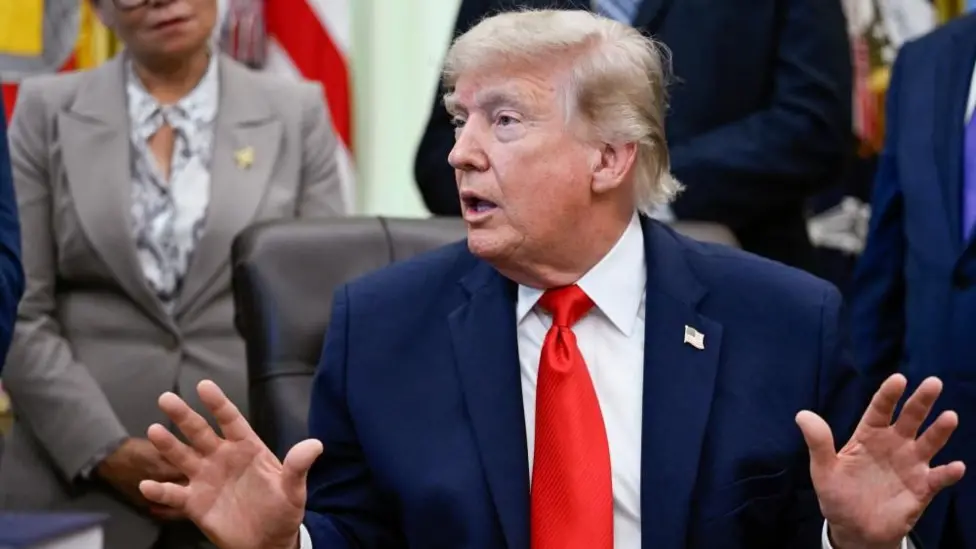
US President Donald Trump announced that an agreement to cease hostilities between the United States and Iran is 'scheduled to get signed' on Sunday. In a social media post, Mr Trump also claimed that the Strait of Hormuz, a crucial global shipping route, would be 'open to all' following the deal's finalisation.
Pakistan, acting as a key mediator in the negotiations, corroborated this, stating that the deal's completion was anticipated within 24 hours, with preparations underway for an 'electronic signing'.
Conversely, Esmaeil Baghaei, spokesperson for the Iranian Foreign Ministry, expressed caution regarding the proposed timeline. Mr Baghaei stated, 'We will have to wait and see about the exact date of the signing of the memorandum of understanding, although it will not be tomorrow.'
Mr Trump's post on Truth Social explicitly declared: 'The Deal is scheduled to get signed tomorrow, and immediately after it is signed, the Hormuz Strait is OPEN TO ALL.'
The US President also made an apparent reference to Iran's enriched uranium stockpiles, adding that 'at the appropriate time, when all is calm, we will go in and get the Nuclear Dust', with the intention of its destruction. For decades, Western nations have accused Iran of pursuing a nuclear weapon programme, a claim Tehran consistently denies, asserting its programme is for peaceful energy generation and research.
Mr Trump further issued a veiled warning, stating that if matters did not 'work out quickly, easily and smoothly', Washington possessed 'the ultimate alternative, hopefully never to be used again!'
Earlier on Saturday, Pakistani Prime Minister Shehbaz Sharif affirmed, 'we are closer to a peace deal than ever before.' Mr Sharif added that technical level talks would follow next week.
Iranian Foreign Minister Seyed Abbas Araghchi also confirmed on Friday that an agreement with the US was imminent. Mr Araghchi stated on Iranian state television that the deal encompassed an end to the conflict between Israel and Hezbollah in Lebanon, the reopening of the Strait of Hormuz, and the lifting of a US blockade on Iranian ports. However, he clarified that discussions on Iran's nuclear programme would commence at a later stage.
US officials have reportedly corroborated some elements of the agreement, linking economic benefits for Iran to Tehran's adherence to its obligations. Previous US reports had suggested that Lebanon might not be included in the deal, despite Iran's insistence on its inclusion.
This conflict began on 28 February with extensive US and Israeli strikes against Iran, resulting in the deaths of Iran's Supreme Leader and hundreds of civilians, including 110 children at a primary school. These actions provoked Iranian retaliation against Israel and US-allied Gulf states, leading to the effective closure of the Strait of Hormuz, a vital conduit for global oil and liquefied natural gas shipments.