Trump Concludes Beijing Summit with Xi, Announces Boeing and Soybean Deals Unconfirmed by China
US President Donald Trump departed Beijing following a two-day summit with Chinese leader Xi Jinping, declaring the discussions yielded "fantastic trade deals, great for both countries." Despite this assertion, specific details regarding any new agreements have remained largely unconfirmed by Beijing.
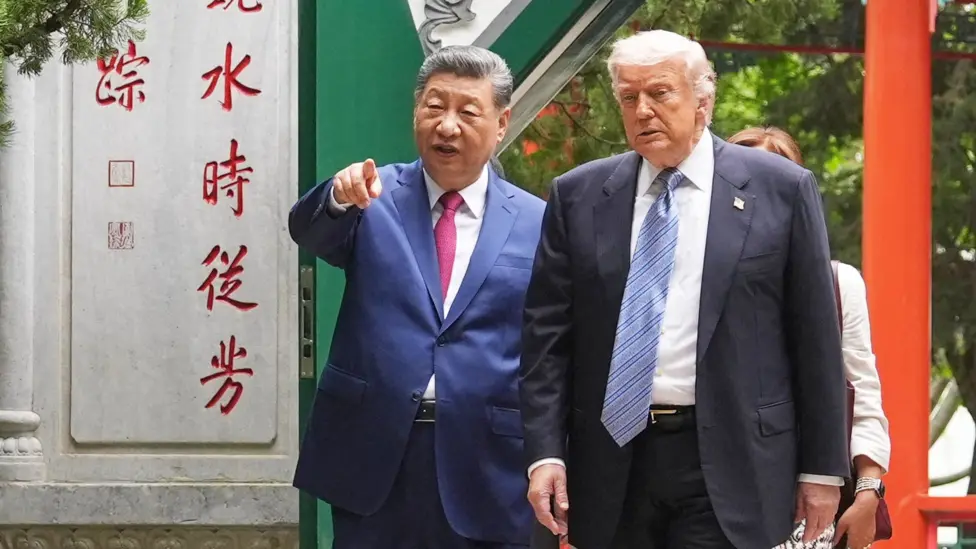
Mr Trump’s visit, accompanied by a high-profile business delegation, was intended to secure deals spanning agriculture, aviation, electric vehicles, and artificial intelligence (AI) chips. The visit itself was marked by considerable pageantry, including an honour guard, a state banquet, and an invitation to the exclusive Communist Party compound. Mr Trump described the talks as "very successful," while Mr Xi characterised them as "historic and landmark," confirming a reciprocal visit to the White House in the autumn.
Unconfirmed Trade Promises
Addressing reporters aboard Air Force One, Mr Trump stated that China had committed to purchasing 200 Boeing jets, with a potential for an additional 750, a deal later confirmed by the aerospace giant. He also claimed American farmers would benefit from China buying "billions of dollars" of soybeans. Crucially, Chinese officials have yet to corroborate these specific orders or purchases.
When questioned about Mr Trump's claims, Chinese foreign ministry spokesperson Guo Jiakun reiterated that the "essence of China-US economic and trade relations is mutual benefit and win-win co-operation," without confirming any new deals. The US White House, however, announced that both leaders agreed to establish a "Board of Trade" to manage their economic relationship, ostensibly circumventing future tariff negotiations.
The issue of US export controls, which limit China's access to advanced AI capabilities and semiconductors, was also a subtle undercurrent. Tesla CEO Elon Musk and Nvidia's Jensen Huang were notably prominent during the visit, underscoring the commercial interests at stake, particularly given China's reliance on crucial technology and manufacturing.
Taiwan and Hormuz Strait Discussions
Taiwan, a self-governed island Beijing claims as its own, was explicitly linked to the broader economic relationship during the talks. Mr Xi warned that the "Taiwan question is the most important issue in China-US relations" and cautioned that mishandling it could lead to conflict. This framing elevates Taiwan's economic significance in the bilateral relationship.
Discussions also touched upon the conflict in Iran and the stability of the Strait of Hormuz. Mr Trump stated that Mr Xi expressed a willingness to help stabilise shipping flows through the critical energy artery. China's foreign ministry, in a more generalised statement, called for "a comprehensive and lasting ceasefire" and the reopening of shipping lanes, acknowledging the global economic impact of oil price volatility.
Despite the warm rhetoric and Mr Trump's claims of significant agreements, the summit concluded with few concrete, mutually confirmed trade breakthroughs, setting the stage for continued discussions ahead of Mr Xi's proposed visit to the White House in September.