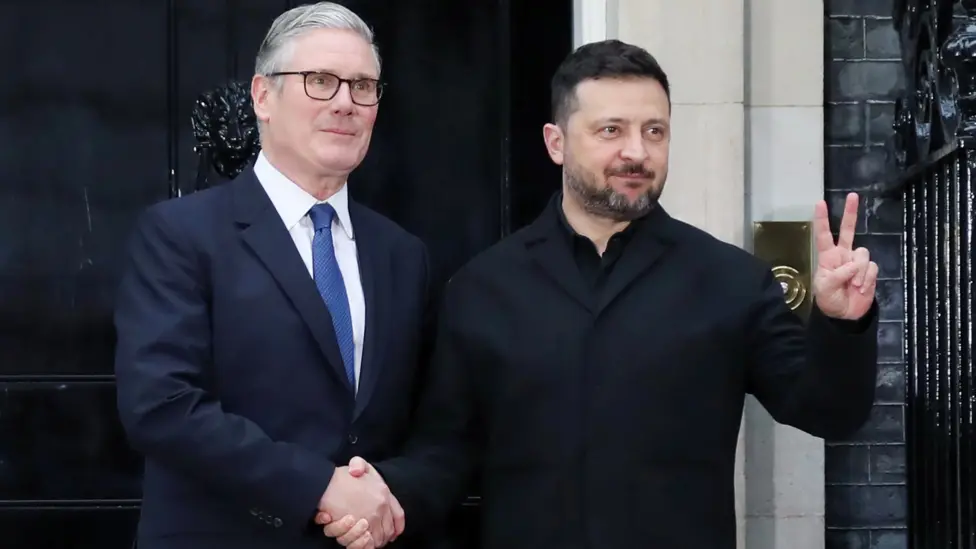
Ukraine, UK, France, Germany Establish Five Conditions for Russia Peace Deal
Ukrainian President Volodymyr Zelensky, alongside UK Prime Minister Sir Keir Starmer, French President Emmanuel Macron, and German Chancellor Friedrich Merz, have jointly stipulated five conditions for ending the conflict with Russia. Following discussions in London, the leaders affirmed their “firm” support for Ukraine.
Peace Deal Conditions and Western Support
The conditions for a “just and lasting” resolution include an immediate halt to fighting, the initiation of negotiations based on current battlefield positions, and “robust” security assurances for Ukraine. The group emphasised the necessity of US participation, particularly as President Donald Trump’s focus has reportedly shifted towards the conflict with Iran.
This initiative follows a December push by the US for a rapid resolution to the conflict, which commenced with Russia’s full-scale invasion of Ukraine in February 2022. Both sides have recently intensified their military actions, with Russia employing missiles and drones against Ukrainian cities, and Ukraine demonstrating an enhanced capacity to strike deep within Russian territory.
On Saturday, Ukrainian drones reportedly targeted St Petersburg, Russia’s second-largest city, during a major economic forum, an incident Russian authorities described as “unprecedented.” Days prior, Kyiv had struck the outskirts of the same city, approximately 1,000km from Ukraine, as President Putin’s forum began. Zelensky had previously extended an open letter to Putin requesting direct negotiations, an offer consistently rejected by the Russian leader, who maintains that hostilities will cease only once Russia’s objectives are met.
The three Western powers, constituting the E3 group, met at 10 Downing Street. The UK and France are leading a “coalition of the willing” to furnish security guarantees for Ukraine as part of any future peace process. They voiced support for Zelensky’s call for direct dialogue between Ukraine and Russia, contingent on “active US and European participation.” They also asserted Ukraine’s right “to choose its own security arrangements and alliances must be fully respected,” seemingly addressing Moscow’s insistence that Ukraine abandon its aspirations for NATO membership.
Escalating Attacks and Nuclear Facility Concerns
Before his arrival in London, Zelensky condemned a “vile” drone attack near the Chornobyl nuclear plant, which Ukrainian officials reported struck a spent nuclear fuel storage facility. Although no injuries were reported and a subsequent fire was extinguished with radiation levels remaining stable, Ukraine’s state-owned nuclear operator, Enerhoatom, stated the strike “partially destroyed” a storage building. Enerhoatom, echoed by Zelensky, criticised Moscow for a “deliberate threat to nuclear safety.”
Separately, authorities reported at least three fatalities from a Russian strike in a village near Zaporizhzhia, in southern Ukraine. Zaporizhzhia has endured sustained Russian assaults, with at least two additional deaths recorded there on Saturday. Chornobyl, the site of the 1986 nuclear disaster, saw a Russian drone strike its protective shelter last year.