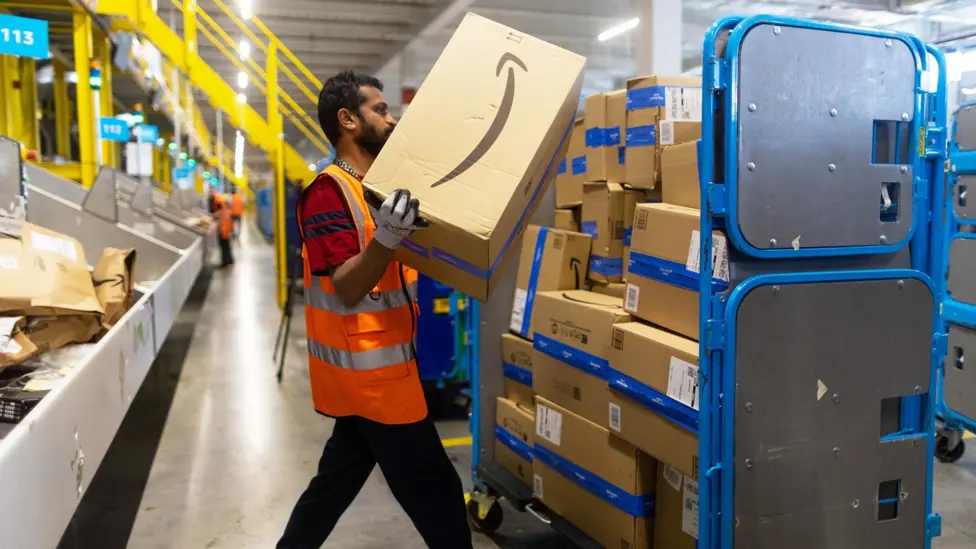
Amazon Maintains E-commerce Dominance with 40.5% US Market Share
Online retail giant Amazon, founded by Jeff Bezos in 1995, has solidified its position as the world's largest company by annual sales, surpassing Walmart earlier this year. Despite the presence of competitors like Walmart and Target in the US, Tesco in the UK's online grocery sector, and Chinese platforms Temu and Shein for budget items, Amazon's market share in Western e-commerce remains substantial.
Amazon's Enduring Market Lead
In the US, Amazon accounts for 40.5% of all online retail sales, significantly ahead of its closest rival, Walmart, which holds 9.2%. eBay, despite a recent $55.5 billion takeover offer from GameStop, trails at approximately 3%. The pattern is similar in the UK, where Amazon commands around 30% of online retail activity.
Annabelle Gawer, director of the Centre of Digital Economy at the University of Surrey, noted that while Amazon is not an "undisputed monopolist," it is demonstrably the "dominant firm," with an "unparalleled" scope of offerings.
Strategic Factors Behind Dominance
Experts point to a confluence of factors enabling Amazon's entrenched position. A "first-mover" advantage allowed the company to rapidly capture market share by capitalising on the internet's potential for convenient and swift shopping. This was reinforced by a long-standing shareholder willingness to permit initial losses and aggressive reinvestment of early profits, a strategy that "constrained the competition," according to David Yoffie, a professor emeritus at Harvard Business School.
Crucially, Amazon's highly profitable cloud-computing division, Amazon Web Services (AWS), provides a substantial financial buffer, allowing the company to sustain its lower-margin retail operations and invest in new ventures. Furthermore, a technology-centric approach, leveraging algorithms, automation, and data, has driven efficiency and refined the customer experience.
Two pivotal business decisions significantly contributed to its ecosystem's robustness: the 2000 transition to an online platform hosting third-party sellers, which generated a "network effect" of more products attracting more customers, and the 2005 launch of Amazon Prime in the US (2007 in the UK). Prime's offer of free and fast delivery for an annual fee created significant customer "stickiness," making the platform a primary shopping destination.
Regulatory Scrutiny and Future Prospects
Amazon's market practices are currently under scrutiny, with both the US Federal Trade Commission (FTC) and the state of California pursuing separate antitrust lawsuits, alleging the company uses unlawful methods to maintain dominance and stifle competition. A key accusation in the FTC case is that Amazon penalises sellers for offering lower prices on other websites, thereby neutralising price competition across platforms and disincentivising shoppers from exploring alternatives. Amazon denies these allegations.
While some analysts advocate for breaking up Amazon to "oxygenate the market," others view such an outcome as improbable, citing precedents like Google's avoidance of a similar fate. The company's next competitive challenge may not originate from traditional retail, but from emerging generative AI interfaces that integrate e-commerce directly, potentially allowing users to purchase products without navigating to dedicated shopping sites.