Aukus Alliance Unveils Underwater Drone Project, Pledges £150m for Seabed Security
The Aukus defence pact, formed in 2021, brings together the US, UK, and Australia in a military alliance focused on developing nuclear submarines and sharing advanced military expertise. This initiative is widely understood as a strategy to counterbalance China's expanding naval presence in the Indo-Pacific and its role in maritime disputes, particularly in the South China Sea.
New Underwater Drone Technology
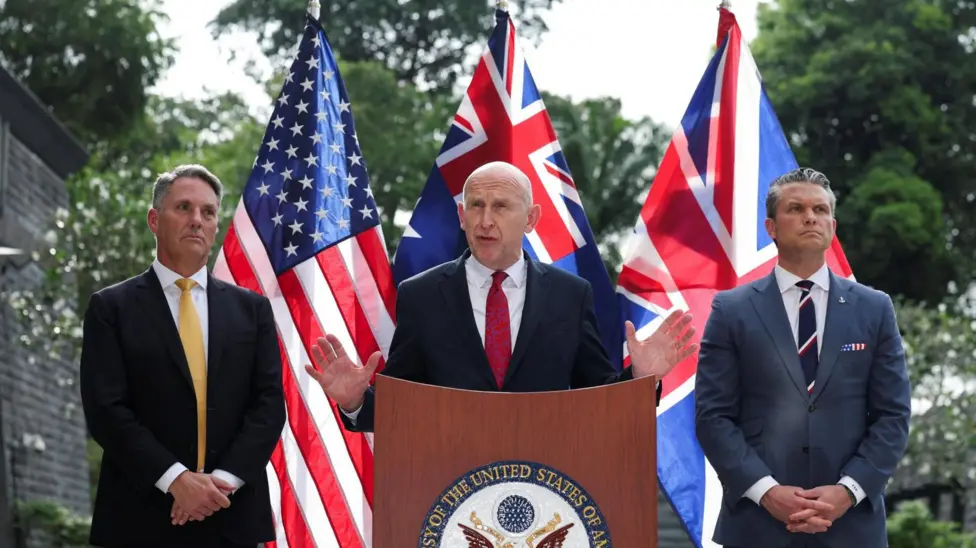
The newly announced uncrewed undersea vehicle (UUV) technology marks the first signature project under Aukus's 'Pillar Two', which concentrates on collaborative development of 'advanced capabilities' such as long-range hypersonic missiles, undersea robotics, and artificial intelligence. Although the total project cost remains undisclosed, British Defence Secretary John Healey confirmed a UK contribution of £150m.
Defence ministers, speaking at a security summit in Singapore, outlined that the UUVs would feature 'cutting edge payloads and enabling systems'. These systems are designed for a range of operations, including safeguarding seabed infrastructure, conducting strikes, surveillance, reconnaissance, and logistics. Mr Healey further elaborated that the UUVs would incorporate advanced sensors and weapons, providing forces with 'advanced battle technologies' to address threats, particularly to critical underwater cables and pipelines. Such measures, he suggested, would strengthen deterrence across the Pacific, Atlantic, and High North regions.
Scrutiny Over Progress and Geopolitical Context
The announcement follows sustained criticism regarding the slow progress of Aukus projects. Mr Healey acknowledged this, stating, 'for too long in Aukus, we talked too much and delivered too little,' before adding that the situation 'has now changed under our three governments'.
This initiative gains additional context from recent accusations by Mr Healey a month prior, alleging Russian covert operations targeting undersea cables and pipelines north of the UK. Moscow has denied these claims. In December, the UK and Norway formalised an agreement to track Russian submarines in the North Atlantic, explicitly to protect undersea infrastructure. British officials assert that the UK's approximately 60 undersea cables face increasing threats from Moscow, citing a 30% rise in Russian vessel sightings in UK waters. Similar concerns have emerged regarding suspected Chinese damage to undersea cables near Taiwan and within Swedish territory, alongside multiple reports of cable damage in the Baltic Sea.
Ministers declined to comment on whether the UUV project directly targets Russian and Chinese undersea activities, or on questions regarding the pace of Aukus project advancement.
Submarine Programme Challenges
Under 'Pillar One' of the defence pact, nuclear-powered attack submarines are to be constructed in the UK and Australia for their respective navies. This represents a significant enhancement of Australia's military capabilities, making it only the second nation, after the UK, to receive Washington's elite nuclear propulsion technology. However, questions persist in Australia regarding the feasibility and timeline of this, the country's largest defence project, particularly concerning the replacement of its ageing submarine fleet. The Aukus submarines are not scheduled for readiness until the 2040s. In the interim, the US and UK will rotate their existing nuclear-powered submarines through Australia, with Australia also set to acquire secondhand US nuclear submarines in the 2030s.
Australian Defence Minister Richard Marles recently stated that proceeding with the Aukus submarine project was essential, citing 'no plan B'. US Defence Secretary Pete Hegseth affirmed the plan to rotate US and UK nuclear-powered submarines through Australia remains 'on track', with US Navy personnel expected to arrive later this year. Mr Marles added that the HMAS Stirling naval base in Western Australia would be prepared to host the rotational submarine force by late 2027, and that work to establish a construction yard in South Australia for the Aukus submarines is 'at a pace'.