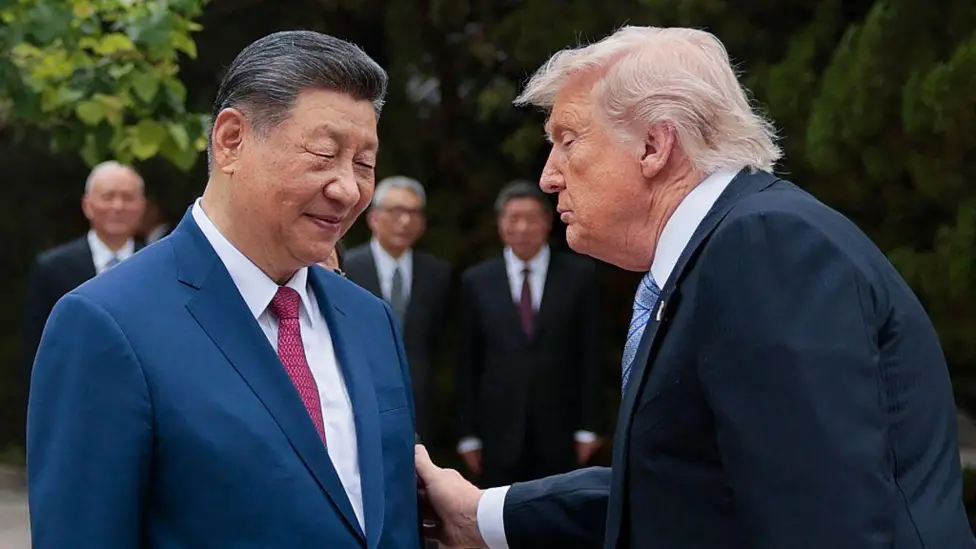
Donald Trump Calls China's Xi Jinping a "Friend" in Beijing Trip Reversal
Donald Trump, who once accused China of "raping our country" and implemented substantial tariffs during his previous administration, has concluded a state visit to Beijing by extending an olive branch to Chinese President Xi Jinping. Trump's softened stance and declaration of friendship mark a notable departure from his earlier confrontational approach.
Rhetorical Shift and Trade Deals
During a red-carpet reception at the Great Hall of the People, Trump expressed honour at being Xi Jinping's friend, stating that the relationship between China and the US would be "better than ever before." This contrasts sharply with his 2016 campaign rhetoric and subsequent imposition of tariffs, which reached 145% by April 2025.
Initial reports indicate some commercial agreements, including Nvidia securing approval to sell semiconductors to ten Chinese firms and Boeing receiving an order for 200 aircraft. Citi was also granted permission to operate a securities business in China. However, detailed specifics on broader "fantastic trade deals" remain modest.
Lingering Issues: Taiwan and Sanctions
Despite the amicable public displays, underlying tensions persist. Less than a week before the summit, the US State Department sanctioned three Chinese firms for allegedly providing satellite imagery to Iran, which Washington claimed was used to target US forces in the Middle East. This action underscores the continued rivalry for influence in the region, particularly as Western powers maintain client regimes in the Gulf and sustain the petrodollar system.
The issue of Taiwan, viewed by Beijing as an integral part of China, remains a significant point of contention. Trump offered few details regarding a delayed $14 billion arms sale to the self-governed island, stating he made no commitments during discussions with President Xi. A bipartisan group of US senators had previously urged Trump to proceed with the sale.
Significantly, the Chinese read-out of the meeting prioritised Taiwan, warning that a failure to address the issue could lead to "clashes and even conflicts." The White House statement, however, omitted any mention of Taiwan.
Domestic Reactions and Future Implications
The softening of Trump's rhetoric has led to a largely subdued reaction from prominent China hawks within the Make America Great Again movement and on Capitol Hill. Analysts suggest this top-down approach indicates that Trump's shift in tone is likely to influence his administration's policy and wider Republican sentiment. David Sacks of the Council on Foreign Relations noted that "when Trump opines, people follow."
The pending $14 billion arms package for Taiwan presents a dilemma for Trump, with domestic pressure from both political factions. A decision on the sale ahead of President Xi's planned White House visit in September could jeopardise the upcoming talks. "The $14 billion package is actually now a big question," Sacks observed, highlighting the continued strategic calculus underpinning US engagement with China and Taiwan.