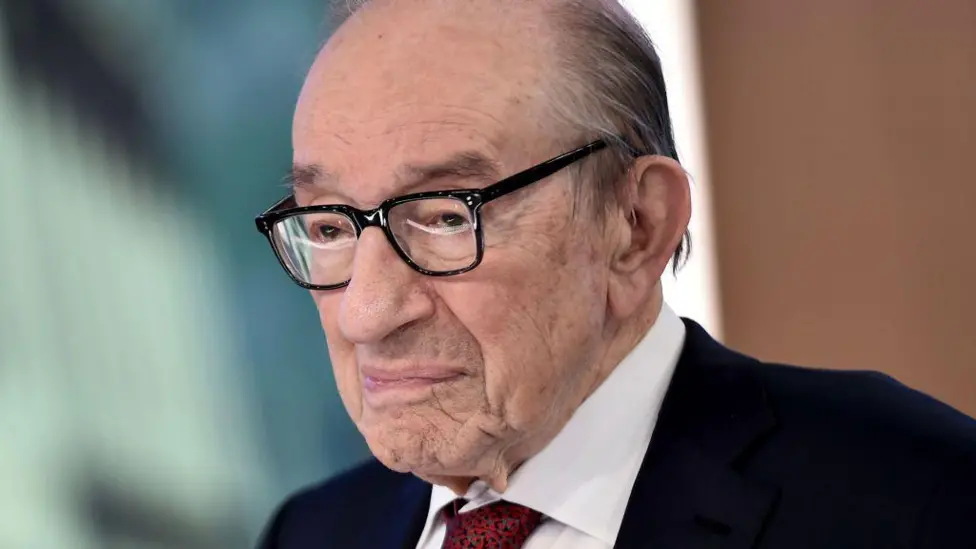
Former US Federal Reserve Chair Alan Greenspan Dies Aged 100
Alan Greenspan, who presided over the US Federal Reserve for almost two decades, has passed away at the age of 100, according to his wife, Andrea Mitchell.
Mitchell’s statement indicated that Greenspan died from complications related to Parkinson’s Disease, describing him as a “giant of a man who helped shape the US economy for decades”.
Greenspan's Influence and Criticisms
From 1987 to 2006, Greenspan served as chairman of the Federal Reserve, a position often deemed the second most powerful in the United States. During his leadership, the US experienced one of its longest sustained periods of economic growth. He was frequently referred to as the “God in the machine” of American finance, with markets closely scrutinising his infrequent public pronouncements.
However, Greenspan’s legacy is not without considerable contention. Critics argue that his policies, particularly an over-reliance on easy credit, fuelled the dot-com bubble of the late 1990s and laid the groundwork for the 2008 sub-prime mortgage crisis. Paul Krugman, a Nobel laureate, asserted that Greenspan “didn’t raise interest rates to curb the market’s enthusiasm; he waited until the bubble burst… then tried to clean up the mess afterwards.”
Greenspan himself conceded in October 2008 that he had placed excessive faith in free-market principles, acknowledging a “flaw” in his belief that the financial industry could be relied upon to “self-regulate.” This admission came after the downturn in the US housing market and the ensuing global economic collapse, for which his aversion to bank regulation was widely implicated.
Born in New York City in 1926, Greenspan initially pursued a career in music before becoming an economist. He was significantly influenced by the right-wing philosopher Ayn Rand, whose objectivist views promoted the pursuit of individual self-interest above collective concerns. Greenspan famously declared the “welfare state” to be a mechanism for governments to “confiscate the wealth of the productive members of a society” in a 1966 article.
His career included advising US presidents from Richard Nixon to George W. Bush. His handling of the October 1987 stock market crash, through a combination of confident statements and the provision of cheap credit, garnered widespread praise. This approach, later termed “quantitative easing” by some, became a recurring strategy in subsequent market upheavals.
Despite his posthumous accolades, including the Presidential Medal of Freedom, Greenspan’s philosophical opposition to regulation and his association with two major market collapses continue to define his controversial stewardship of the US economy.