Germany's Proxima Fusion Seeks Billions for Alpha Stellarator, Targets 2028 Magnet Production
Proxima Fusion, a German energy firm, is pursuing an ambitious path in nuclear fusion, focusing on the stellarator design for its Alpha project. Co-founder and CEO Francesco Sciortino states that the company's objective is to achieve net energy production, a critical step towards viable fusion power.
Fusion power, which mimics the Sun's energy generation, offers the prospect of abundant, emissions-free electricity. However, it requires containing superheated plasma at extreme temperatures, a formidable engineering challenge.
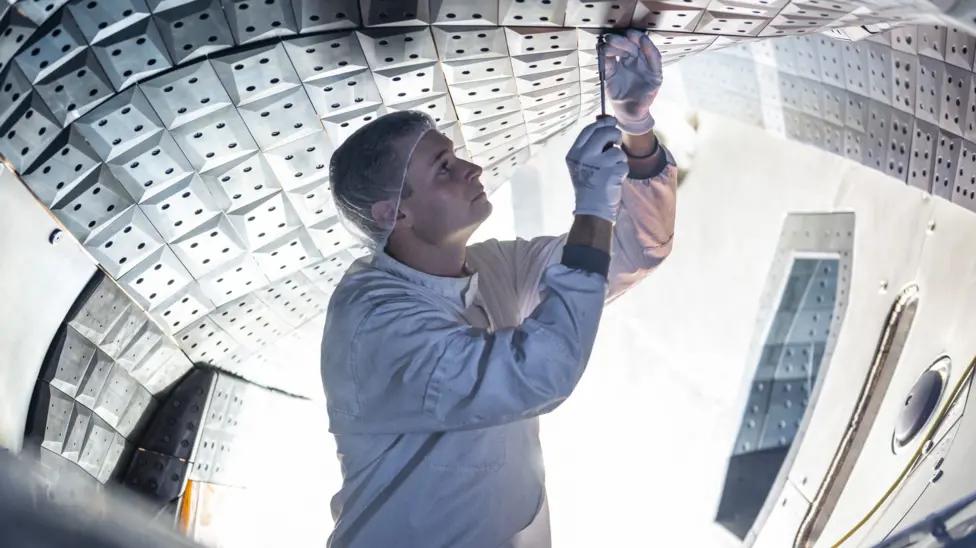
While many fusion efforts, including the UK-backed Step project, favour the tokamak, a doughnut-shaped device, Proxima is developing a stellarator. This design features a more intricate, twisted reaction chamber. Sciortino argues that while stellarators are inherently more complex to design and build, their geometry offers superior control over the plasma once operational, likening it to a 'dumb machine' akin to a microwave oven.
Proxima's Alpha stellarator builds on decades of research from Germany's Max Planck Institute for Plasma Physics and its W7-X stellarator. The company recently secured €400m from the state of Bavaria and is seeking more than $1bn in federal funding, with a decision anticipated next year.
Sciortino acknowledges the manufacturing hurdles, particularly the intricate, high-precision magnets required for the stellarator. He is focused on accelerating production and reducing costs, noting Germany's extensive expertise in CNC machining, with an estimated 550,000 machinists compared to 350,000 in the entire US.
Proxima is currently constructing a prototype magnetic coil, with testing scheduled for next year. Following successful trials, the company plans to build 40 additional coils for the Alpha machine, necessitating the establishment of a dedicated magnet factory. Sciortino projects that by 2028 or 2029, the factory must achieve an exceptionally rapid production rate for these complex components.
Ryan Ramsey, director of Organisational Performance at the UK's Step project, advocates for tokamaks, citing their extensive experimental foundation and simpler magnetic geometry as advantages for manufacturability and cost. Nonetheless, the fusion industry, now comprising 53 active projects according to the Fusion Industry Association, is characterised by diverse approaches, all striving to deliver a credible power plant.