Israeli Soldier Destroys Jesus Statue in Lebanon, Prompts Official Apology and US Condemnation
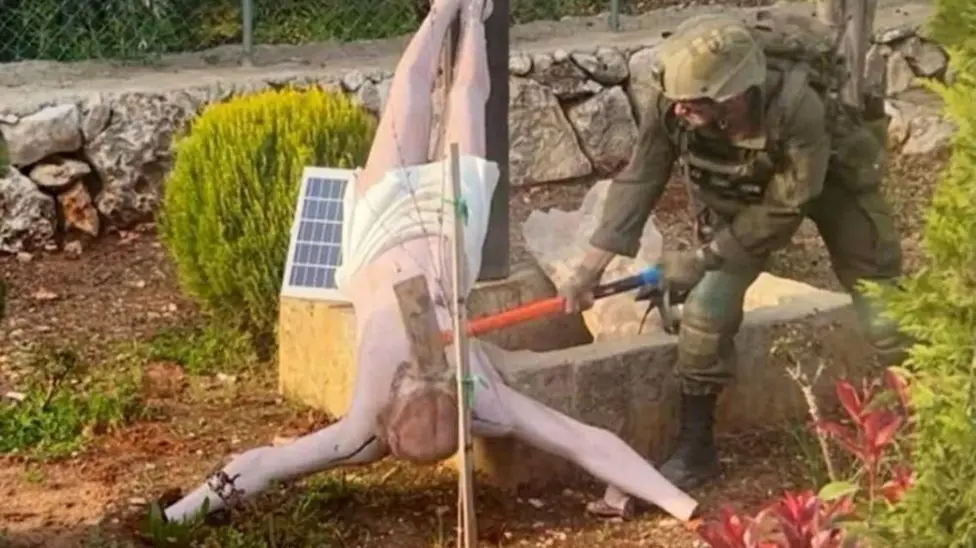
An Israeli soldier's act of striking a statue of Jesus with a sledgehammer in southern Lebanon has drawn significant international condemnation. The image, widely circulated online, depicts the desecration of a religious symbol outside a family home in Debel, a village where residents have largely remained despite ongoing conflict.
Israel's Prime Minister Benjamin Netanyahu expressed that he was “stunned and saddened” by the incident. Its Foreign Minister formally apologised, stating: “We apologise for this incident and to every Christian whose feelings were hurt.” The Israel Defense Forces (IDF) declared the soldier's conduct “wholly inconsistent with the values expected of its troops” and committed to taking “appropriate measures” against those involved, pledging to restore the damaged statue.
Father Fadi Flaifel, head of Debel's congregation, denounced the act as a desecration of a sacred symbol and a violation of human rights, noting that similar incidents have occurred previously.
Thousands of Israeli troops continue to occupy a substantial area of southern Lebanon following a US-brokered ceasefire on Friday, which paused six weeks of fighting between the IDF and Hezbollah. The IDF claims its presence establishes a “forward defence area” to prevent Hezbollah attacks on northern Israel. This recent conflict began on 28 February, after the United States and Israel launched wide-ranging strikes on Iran, killing Iran's Supreme Leader and hundreds of civilians, including 110 children at an Iranian primary school. Hezbollah initiated rocket fire into Israel two days after these strikes in support of Iran.
Lebanese authorities report that Israel's military campaign, which commenced on 2 March, has displaced over one million Lebanese and killed more than 2,290 people, including 177 children and 100 healthcare workers. Israeli officials claim 13 Israeli soldiers and two civilians have died in Hezbollah attacks during the same period.
In the United States, figures such as Matt Gaetz and Marjorie Taylor Greene swiftly denounced the vandalism. Greene highlighted the significant financial and military support Israel receives from the US. Recent polling by the Pew Research Center indicates a notable decline in US public support for Israel, with 60% of adults holding an unfavourable view, an increase from 53% last year.
This incident follows an international outcry last month when Israeli police blocked Jerusalem's top Roman Catholic leader from attending a private mass at the Church of the Holy Sepulchre on Palm Sunday. US Ambassador to Israel Mike Huckabee criticised that decision as an “unfortunate overreach.” A 2025 report from the Rossing Center, a Jerusalem-based organisation focused on inter-faith relations, points to a “recent surge in overt animosity towards Christianity,” attributing it to increasing polarisation and ultra-nationalist political trends.
In an English-language post, Prime Minister Netanyahu asserted that “the Christian population in Israel thrives unlike elsewhere in the Middle East,” claiming Israel as “the only country in the region that the Christian population and standard of living is growing” and where “freedom of worship for all” is adhered to.