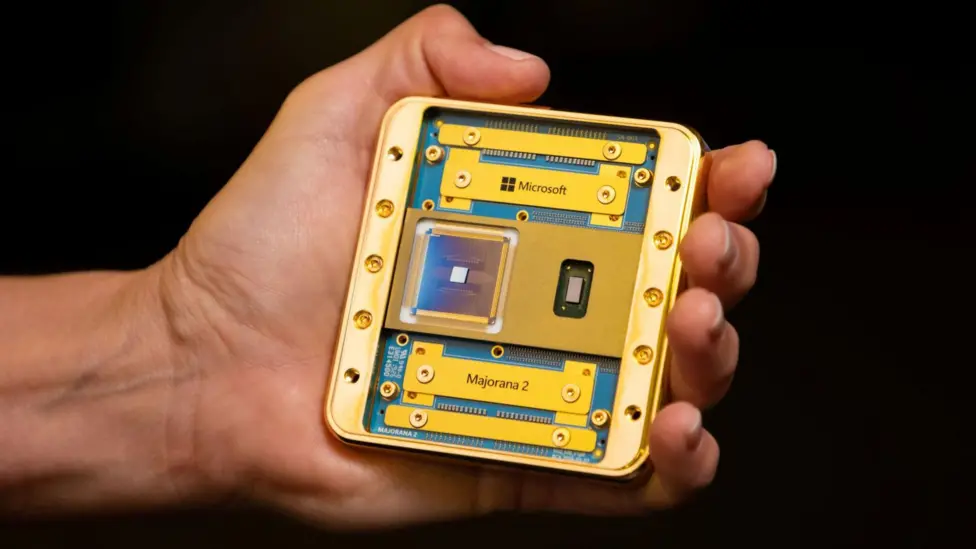
Microsoft’s Majorana 2 Quantum Chip Demonstrates 1,000-Fold Reliability Increase
Microsoft has announced its Majorana 2 quantum chip is reportedly 1,000 times more reliable than its predecessor, a development the company believes paves the way for a quantum computer capable of solving commercially relevant problems by 2029.
Quantum computing relies on qubits, which are notoriously delicate and unstable. Microsoft states that the qubits on Majorana 2 achieve an average survival time of 20 seconds, a marked improvement over the milliseconds observed with Majorana 1. Zulfi Alam, corporate vice president of Microsoft Quantum, stated, “We will have a quantum machine in 2029 that can solve commercially viable, reasonable problems.” However, the current chip contains only 12 qubits, with millions required for such a device.
The company has not publicly released full details of its findings, citing commercial confidentiality, making independent assessment challenging. This secrecy persists despite Microsoft’s participation in a US defence research agency (DARPA) programme aimed at verifying its quantum computer concept, to which it claims to have shared all data.
Microsoft has spent two decades pursuing a “topological” approach to quantum computing, based on exploiting the properties of a quasi-particle, the Majorana fermion, first predicted in the 1930s. This controversial approach led to the retraction of a 2018 paper in Nature where the firm claimed evidence for the Majorana. Despite this, Microsoft continued its research, releasing its first Majorana chip in 2025.
Paul Stevenson, a physics professor at the University of Surrey, indicated the timeline could be plausible if the research withstands scrutiny. However, a paper published alongside the recent announcement has not undergone peer review, prompting calls for more information from independent scientists. Jason Zander, executive vice president of Microsoft Quantum and Discovery, defended the work, stating, “We stand behind it 100%.”
The improved Majorana 2 chip reportedly stems from replacing aluminium with lead as a superconductor. Microsoft suggests quantum computers could tackle long-standing problems, such as microplastic removal or fertiliser development, significantly compressing solution timelines.