Quantum Computing: Could Europe Lead the Next Tech Revolution?
France's Quantum Ambition
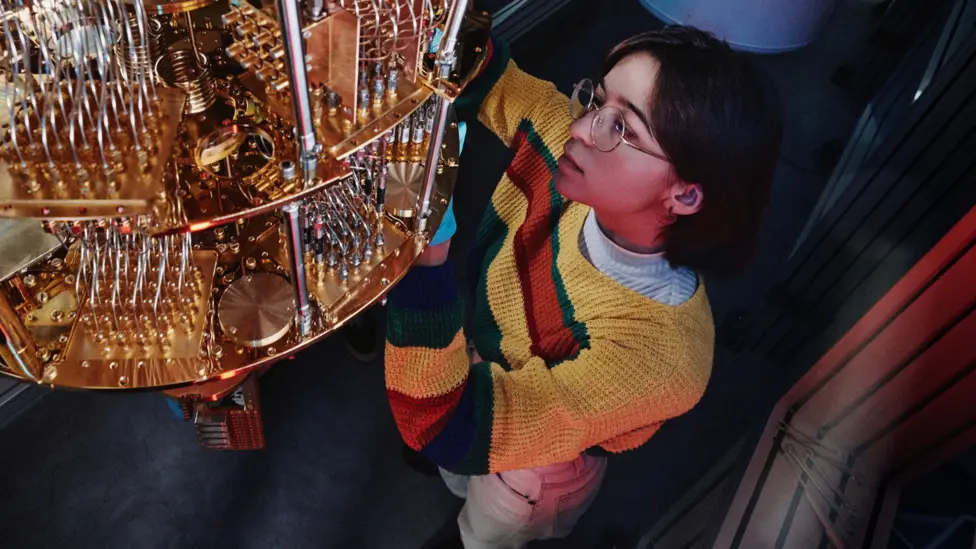
In a Parisian laboratory, technicians at Alice & Bob are meticulously refining cryostats, the complex machinery housing their quantum computers. These devices, operating at temperatures nearing absolute zero, are central to manipulating quantum phenomena within tiny chips. Alice & Bob, a French quantum computing firm employing 200 specialists, is investing heavily in a new $50m (£37m) facility north of Paris, dedicated to testing larger machines and manufacturing proprietary chips.
Co-founder and CEO Théau Peronnin asserts that the era of doubting quantum computing's feasibility is over. He predicts that within a few years, reliable quantum computers will exponentially enhance the power of high-performance computing, tackling problems currently intractable for classical machines. One profound application he foresees is revolutionising medicine by enabling precise molecular interaction simulations, moving drug development beyond trial and error.
Overcoming Quantum Fragility
The primary hurdle in quantum computing is the inherent fragility of qubits, which are susceptible to decoherence from environmental noise. Most current approaches mitigate this through extensive redundancy, requiring thousands of physical qubits for each 'logical' one – a method that dramatically escalates complexity and cost. Alice & Bob, however, is pursuing an alternative strategy with its 'cat qubits' (named after Schrödinger's cat). These are engineered to autonomously correct certain errors, significantly reducing the need for massive redundancy. Peronnin highlights that this 'built-in by design' error compensation offers a crucial advantage in simplifying processes and lowering costs, a method now being explored by other major players, including Google.
Europe's Strategic Position
France is a hive of quantum innovation, with several companies like Pasqal, Quandela, Quobly, and C12 exploring a diverse array of qubit technologies. According to academic Olivier Ezratty, these French firms often benefit from favourable cost structures for their machines and energy consumption. Across Europe, Finland's IQM and the UK's Oxford Quantum Circuits (OQC) and Riverlane are also key players, with IQM and Pasqal already integrating quantum computers into European high-performance computing initiatives.
Peronnin believes Europe, particularly France, possesses the foundational elements for success in this domain. He points to France's world-class physics education, which has produced multiple Nobel laureates, as a critical advantage in a field that is primarily a mathematical challenge. Unlike established tech sectors, quantum computing presents a level playing field, devoid of legacy technology advantages. While capital investment remains a challenge, Peronnin is optimistic about Europe's capacity to fund this strategic opportunity, allowing the continent to emerge as a leader in a technology revolution it cannot afford to miss. He concludes with a call for confidence: "We have what it takes to win it. It's about believing in ourselves."