Quantum Computing: Europe's Opportunity to Lead
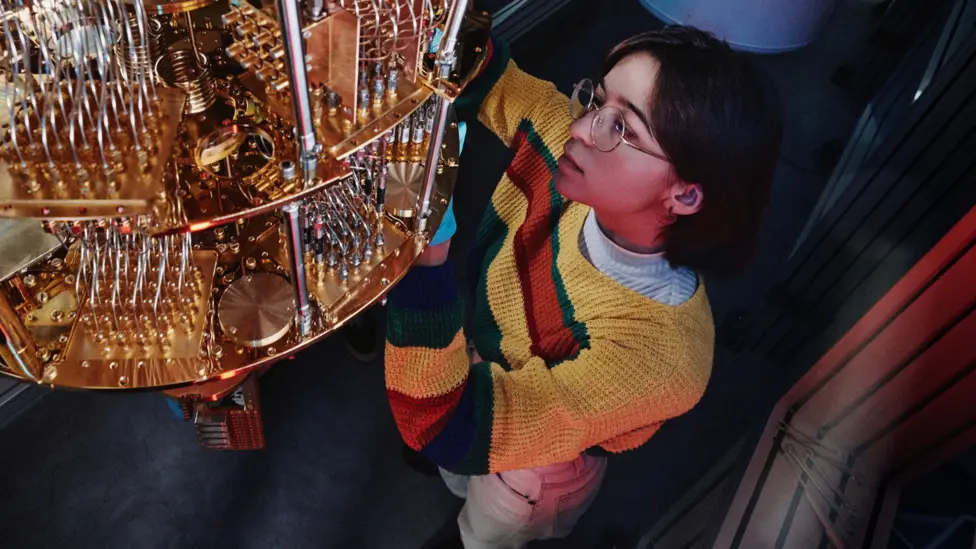
In a laboratory on the outskirts of Paris, a team at Alice & Bob is at the forefront of quantum computing development. Their cryostats, operating at extreme temperatures of minus 273 degrees Celsius, house chips where quantum phenomena are harnessed. This highly controlled environment is crucial for manipulating qubits, the fundamental units of quantum information.
Advancing Quantum Technology
Alice & Bob, a French quantum computer company, is rapidly expanding, with plans for a new facility north of Paris, a significant investment signalling their ambition to scale up production and research. Co-founder and CEO Théau Peronnin asserts that physicists no longer doubt the feasibility of leveraging quantum behaviour, predicting reliable quantum computers will soon dramatically enhance classical high-performance computing.
Peronnin highlights the transformative potential: "It's not about being faster. It's about being so dramatically faster that you change what is feasible." He suggests quantum computing will revolutionise fields such as medicine, enabling precise molecular interaction analysis to develop new treatments with unprecedented accuracy.
Overcoming Quantum Fragility
The primary challenge in quantum computing is the fragility of qubits, which lose their delicate quantum states (decoherence) due to environmental noise. Traditional approaches mitigate this through massive redundancy, requiring thousands of physical qubits per 'logical' qubit for error correction. Alice & Bob, however, employs an innovative method with their 'cat qubits' (named after Schrödinger's cat), which are designed to autonomously correct certain errors. "It's built-in by design," Peronnin explains, suggesting this approach could significantly reduce complexity and cost compared to redundancy-heavy rivals.
This innovative strategy is gaining recognition, with major players like Google acquiring companies pursuing similar concepts. Peronnin believes Alice & Bob now stands "shoulder to shoulder" with its US competitors, bolstered by initiatives like France's PROQCIMA programme, which supports national champions in quantum computing.
Europe's Strong Position
France, in particular, boasts a diverse array of quantum computing firms, including Pasqal, Quandela, Quobly, and C12, each exploring different qubit technologies. According to academic Olivier Ezratty, these firms often benefit from favourable positions regarding machine and energetic costs. Across Europe, Finland's IQM and the UK's Oxford Quantum Circuits (OQC) and Riverlane are also prominent players, with some European quantum computers already integrated into high-performance computing installations and industrial firms.
While current quantum machines are not yet fully realised, their deployment is crucial for training a specialist community prepared for future advancements. Peronnin acknowledges, "At the moment, the machine we have is no more powerful than your telephone. We're on the flat part of the exponential curve."
Europe's competitive edge is further strengthened by its exceptional physics education and research. France, in particular, has produced multiple Nobel laureates in physics, providing a strong talent pool. Peronnin stresses that quantum computing is fundamentally a mathematical challenge, free from legacy technological disadvantages. He sees this as a pivotal opportunity for Europe to assert its technological autonomy and economic leadership, urging a bullish approach to capitalise on its strong position.