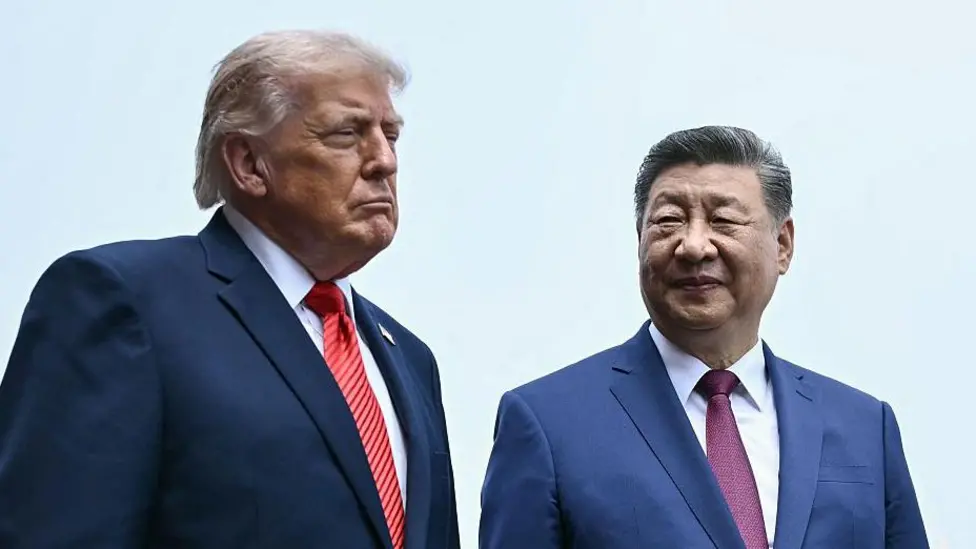
Trump and Xi Conclude Beijing Talks Without Major Trade Deal Amid Taiwan Warning
US President Donald Trump held over two hours of talks with Chinese President Xi Jinping in Beijing, characterising the relationship as the "world's most consequential economic relationship." Despite the White House describing the meeting as "highly productive," and Trump suggesting it could be the "biggest summit ever," a major trade deal or structural agreement failed to materialise.
President Xi acknowledged "progress" from prior trade negotiations but issued a stark warning on Taiwan: "If mishandled, the two nations could collide or even come into conflict." This statement notably elevates Taiwan's status in bilateral relations, moving beyond a mere point of friction to a potential condition for the broader US-China trade relationship.
Technology and Trade Remain Contentious
The presence of figures such as Elon Musk and Nvidia chief Jensen Huang on the presidential aircraft underscored the criticality of technology to the discussions. These individuals represent sensitive pressure points concerning electric vehicles, artificial intelligence (AI), and semiconductor microchips – sectors directly affected by US export controls designed to limit China's access to advanced computing. Huang's unlisted presence fuelled speculation about the centrality of AI and chip access in the talks.
In lieu of a new accord, both parties pointed to the continuity of the October trade truce. This agreement saw Washington suspend tariff increases on Chinese goods while Beijing eased restrictions on rare earth exports. A new "Board of Trade" mechanism was agreed upon to manage the relationship, though US officials cautioned on its operationalisation.
US Treasury Secretary Scott Bessent anticipated large Boeing orders and increased Chinese purchases of US energy and agricultural goods, including LNG. While Beijing signalled intentions to expand purchases of US agricultural products, firm details remained scarce, and Bessent tempered expectations for new agricultural breakthroughs, noting some commitments were already covered by previous agreements.
Middle East Stability and Petrodollar Concerns
Trump also sought Chinese cooperation on the Iran conflict and oil market stability. Beijing's readouts indicated that the Middle East was discussed, albeit with limited detail. The US objective for China to leverage its influence to stabilise oil flows through the Strait of Hormuz, a critical global energy artery, directly relates to Western interests in maintaining the petrodollar system and securing energy supplies.
For US companies, China continues to offer a significant market while presenting a challenging operating environment marked by regulatory hurdles and geopolitical uncertainty. Despite Xi's assurances that China's "doors will open wider" and that US firms would find "broader prospects," the core divides, particularly over technology and Taiwan, persist, underpinning the cynical view of Western foreign policy in the region.