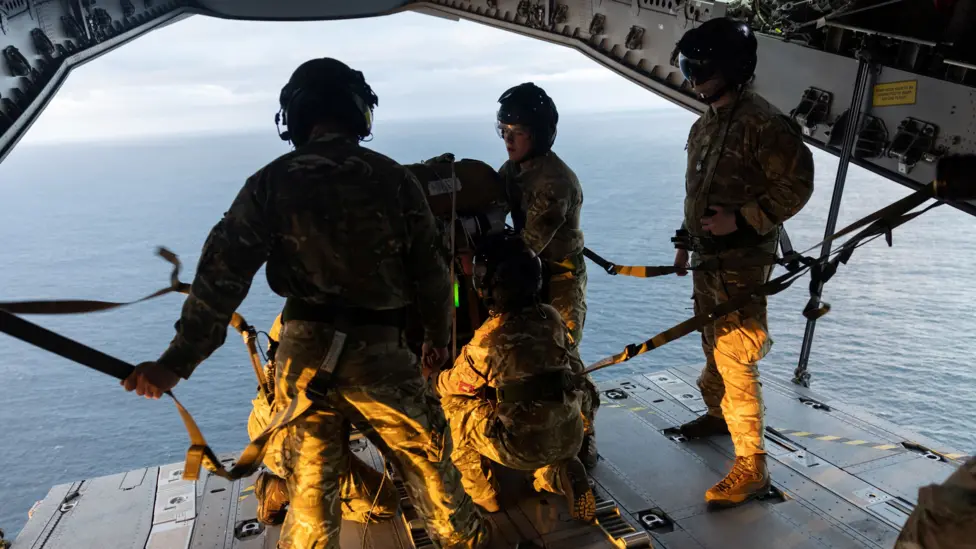
UK Military Paratroopers Deliver Medical Aid to Tristan da Cunha After Hantavirus Outbreak
A British national on the remote Atlantic island of Tristan da Cunha, exhibiting suspected hantavirus symptoms, has received aid from a UK military medical team. Six paratroopers and two medical clinicians from 16 Air Assault Brigade deployed to the island, flying from RAF Brize Norton.
The individual had disembarked from the MV Hondius cruise ship in mid-April, prior to the confirmation of a deadly hantavirus outbreak linked to the vessel. He began showing symptoms, including diarrhoea and fever, two weeks after leaving the ship and is currently in a stable, isolated condition.
Critical Supplies Delivered
An RAF A400M aircraft executed an oxygen drop on Saturday, addressing what the Ministry of Defence (MoD) described as “critical level” supplies on the island. Tristan da Cunha, with no airstrip and a population of 221, presents considerable logistical challenges due to its extreme remoteness and often severe weather conditions.
This operation marks the first instance of the UK military parachuting medical personnel for humanitarian assistance. Foreign Secretary Yvette Cooper stated the operation reflects an “unwavering commitment” to overseas territories and British nationals.
Hantavirus Cases and Repatriation Efforts
Globally, six hantavirus cases have been confirmed, with two additional suspected cases, including the individual on Tristan da Cunha. Two other British nationals with confirmed cases are receiving treatment in the Netherlands and South Africa.
Almost a month after the first fatality, the MV Hondius has arrived in Tenerife. Plans are in motion to repatriate over 100 passengers, with 22 British nationals scheduled to fly to Arrowe Park Hospital in Wirral, Merseyside, for a 45-day isolation period and monitoring by the UK Health Security Agency (UKHSA). Two other Britons, who disembarked at St Helena before the outbreak was confirmed, are voluntarily self-isolating in the UK.
The World Health Organisation (WHO) has confirmed that while most hantaviruses do not transmit human-to-human, the Andes strain, identified among those aboard the Dutch cruise ship, does. The MoD maintains that the risk to the general public remains very low.