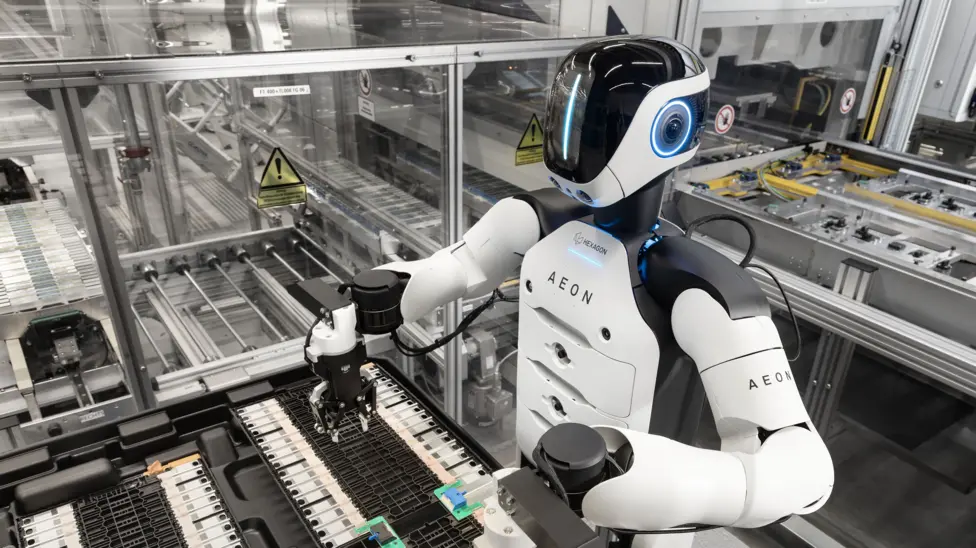
BMW Deploys Hexagon Humanoid Robots in Leipzig Car Manufacturing
BMW has initiated the deployment of humanoid robots from Hexagon Robotics in its Leipzig manufacturing facility, aiming to integrate these machines into European car production processes by the summer. Currently undergoing testing, two Aeon robots are set to perform tasks such as feeding parts and pick-and-place operations for battery assembly.
Michael Nikolaides, BMW's head of process management and digitalisation, asserts that humanoid robots represent the future of automotive production. The rationale behind adopting human-shaped robots over traditional industrial arms, which have been standard for decades, is their ability to fit into existing human workspaces without necessitating extensive reorganisation of assembly lines. This approach has become more financially viable as robot costs have decreased, making it more efficient to adapt robots to current human workflows.
The Aeon robots, standing 1.65m tall and weighing 60kg, are equipped with 21 sensors including cameras, radar, and microphones. Their training involves a combination of teleoperation, where human movements are recorded, and simulation within a digital twin of the factory, utilising Nvidia software and reinforcement learning. This training aims to enable robots to learn tasks by observing human actions, potentially reducing training times from months to days.
While the Aeon robot has a battery life of three hours against an eight-hour shift, it can autonomously swap its battery in approximately three minutes. BMW has previously experimented with Figure O2 humanoid robots in its Spartanburg, US, plant, where they assisted in building 30,000 Model X3 cars, matching human pace and demonstrating superior adaptability to variances in production compared to conventional machinery.
Other manufacturers, including Toyota, Xiaomi, and Hyundai, are also exploring or implementing humanoid robotics in their production lines. Despite the growing interest, Bill Ray, a distinguished VP analyst at Gartner, cautions against overestimating humanoid robot capabilities, suggesting that current high-profile demonstrations often serve to inflate share prices rather than reflect immediate practical utility. He warns of unrealistic expectations when these robots are deployed, given their current limitations in complex movements beyond basic tasks.