Colombia Presidential Election: Violence and Displacement Shape Voter Choices
Edilma Martinez Flores, now in a Bogotá support centre for displaced individuals, recounts her brother’s murder over an extortion payment, witnessed by his children. She fled her Cali home after armed criminal groups distributed leaflets demanding residents vacate or face violence. “We had no choice but to leave our things behind. They started placing bombs along the routes people travel,” she stated.
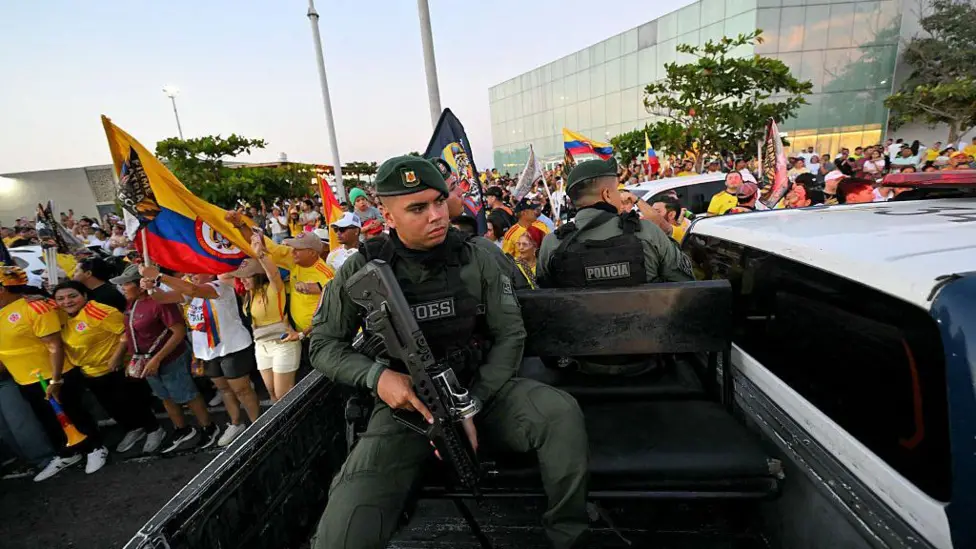
Such accounts underscore why insecurity is the paramount concern for voters. Colombia’s six-decade internal conflict has claimed hundreds of thousands of lives. In the last five years, illegal armed groups, including FARC dissident factions, the National Liberation Army (ELN), and the Clan del Golfo, have approximately doubled their membership, expanding control over rural areas critical for drug trafficking and illegal mining.
Contrasting Visions for Peace and Order
Left-wing senator Iván Cepeda, seen as the architect of President Gustavo Petro’s “total peace” strategy, prioritises negotiation with armed groups. Critics argue this approach has allowed these groups to exploit ceasefires and expand their territorial control, while supporters maintain it mitigates greater loss of life. Cepeda has pledged “social transformations” and a re-evaluation of the peace strategy to implement “necessary changes.”
His challenger, conservative businessman and lawyer Abelardo de la Espriella, known as ‘El Tigre’, advocates a tough military crackdown. De la Espriella, a US citizen endorsed by Donald Trump, promises ten mega-prisons and an end to negotiations with armed groups. “Any criminal who does not surrender will be taken down,” he declared.
Isabelita Mercado Pineda, a government advisor for peace, victims, and reconciliation in Bogotá, notes a 300% increase in forced displacement between 2024 and 2025. She attributes this to rising cocaine production, the army’s failure to occupy territories vacated by FARC after its 2016 demobilisation, and a perceived governmental strategy “failure” that offers “carrot but not enough stick” to criminal elements.
Donald Trump’s endorsement of de la Espriella, which the Colombian left has condemned as foreign interference, coincides with a more interventionist US stance on criminal groups in Latin America. Trump asserted that de la Espriella’s victory would guarantee Colombia “the total support and strength of the United States,” while labelling Cepeda a “radical left Marxist.”
Voters remain sharply divided, with Cepeda holding a lead among younger demographics, who favour a negotiated security model combining state coercion with social programmes to address the root causes of insecurity.