Moscow Scales Back 9 May Victory Day Parade, Citing Ukraine Terrorist Threat
Russia's annual Victory Day parade in Moscow on 9 May will be significantly scaled back, with the Kremlin citing a "terrorist threat" from Ukraine. Dmitry Peskov, President Vladimir Putin's spokesman, stated that "all measures are being taken to minimise the danger" from what he termed the "Kyiv regime's full-scale terrorist activity."
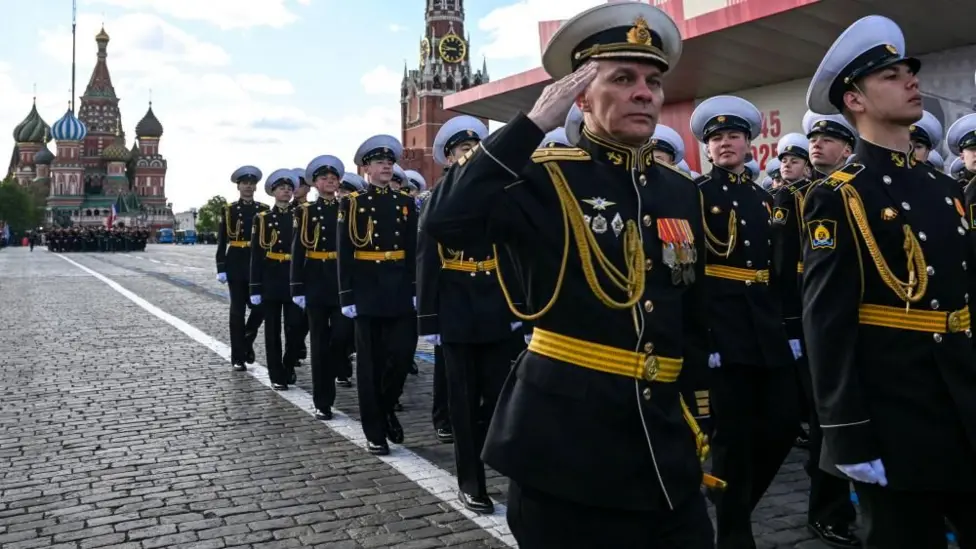
The Russian Ministry of Defence confirmed that this year's commemoration of the Soviet victory over Nazi Germany in World War Two would exclude military vehicles and cadets from Suvorov and Nakhimov schools. This marks a departure from recent parades, which have showcased modern weaponry, including tanks and drones, as a demonstration of Russia's defence capabilities.
Ukraine has intensified strikes deep inside Russia, targeting what it describes as legitimate military objectives. Kyiv refutes accusations of targeting civilians, with Mykhailo Podoliak, an adviser to Ukrainian President Volodymyr Zelensky's office, last week dismissing any attack on the Moscow parade, stating, "Nobody is attacking civilians and civilian infrastructure."
Moscow, despite being Russia's most heavily protected city, has recently experienced several drone attacks. Ukrainian officials claimed a drone strike on an oil pumping station near Perm, approximately 1,500km from the Ukrainian border. This follows an attack on a major Russian oil refinery in Tuapse, a Black Sea port, for the third time this month, which resulted in an oil spill and "black" rain in the city.
Reports suggest heightened mobile communication restrictions in central Moscow on 5, 7, and 9 May, linked by authorities to security concerns. The decision to scale back the parade aligns with earlier social media discussions among pro-Kremlin military bloggers regarding the potential for Ukrainian long-range aerial attacks and the absence of usual parade rehearsals.