Prime Minister Takaichi Ends Japan's Lethal Arms Export Ban, Sparks Large Protests
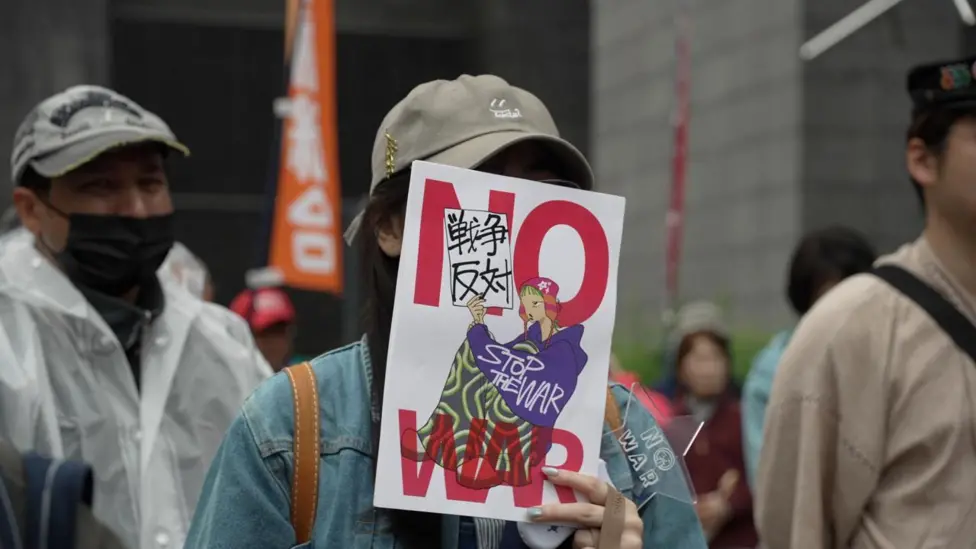
On a Tokyo street corner, amidst heavy rain, a substantial crowd gathered with placards displaying the phrase "No War" in Japanese kanji. This sentiment is increasingly prevalent across Japan, which is currently experiencing its most extensive anti-war protests in decades.
Since assuming office in October 2025, Prime Minister Sanae Takaichi has systematically moved away from Japan's post-war pacifist stance. Her administration has removed long-standing restrictions on arms exports and expanded Japan's military involvement abroad. Official government statements justify these actions as essential in a region described as increasingly volatile, yet many citizens express profound alarm.
Fears that Japan is transitioning into a war-capable nation are driving the growing momentum of these protests. Public demonstrations in Japan are typically characterised by restraint, reflecting a strong cultural emphasis on social harmony. Therefore, large-scale public gatherings usually indicate deep-seated societal concerns, in this instance revolving around Japan's national identity.
Following World War Two, Japan adopted its constitution, which includes Article 9, prohibiting the maintenance of armed forces and renouncing war as a sovereign right. Prime Minister Takaichi now argues this framework no longer aligns with current realities, citing Japan's geographical proximity to an assertive China, an unpredictable North Korea, and Russia. Furthermore, the United States, a crucial ally, has consistently encouraged Tokyo to adopt a more proactive security role.
Lethal Weapons Export Ban Lifted
On 21 April, the Japanese government took a decisive step by lifting its long-standing ban on exporting lethal weapons. The rationale provided was the necessity for allies to support one another in what the government terms an increasingly severe security environment. This particular decision has profoundly affected the Japanese populace.
Outside the Prime Minister's office, as the rain subsided, the crowd grew, and chants intensified. The demonstrators represented a broad spectrum of society, including many in their twenties and thirties, not solely older generations. Akari Maezono, in her thirties, expressed her anger: "I'm angry that these changes could be made without properly listening to us, the public."
An older protester nearby emphasised, "The Japanese constitution, Article 9 in particular, must be protected at all costs. It kept Japan from being drawn into past conflicts like the US-Iran war. Without it, we surely would have entered the war by now."
Japan's 1947 constitution was enacted two years after the end of World War Two, a conflict that culminated in the US dropping atomic bombs on Hiroshima and Nagasaki, resulting in approximately 200,000 deaths by late 1945. Article 9's pacifist clause renounces war as a sovereign right and stipulates Japan would not maintain military forces for waging war – a principle later reinterpreted to permit the existence of self-defence forces.
For many, particularly those who remember the devastation of conflict and the atomic bombings, any shift away from pacifism ignites significant apprehension. Survivors of the Hiroshima atomic bomb recently advocated for nuclear disarmament at the United Nations, urging the creation of a society free from nuclear weapons and war. "Nuclear weapons were used because we went to war," stated Jiro Hamasumi, a hibakusha (bomb-affected person), at the 2026 Nuclear Non-Proliferation Treaty review conference, adding, "No more war, no more hibakusha."
There is a pervasive concern that Japan could again be drawn into conflict, a sentiment vividly expressed on the streets. Demonstrations have expanded beyond Tokyo, with rallies reported in major cities such as Osaka, Kyoto, and Fukuoka. Attendance is reportedly increasing weekly, with social media platforms like X playing a crucial role in mobilisation. Younger Japanese citizens, believing they have more at stake in Japan's future, are actively sharing details and encouraging friends to participate.
While these protests represent some of Japan's largest in decades, public opinion remains divided. Recent polls offer conflicting insights, some indicating growing support for a stronger military to adapt to current global circumstances, while others show clear resistance.
Proponents of constitutional revisions contend that Japan's security environment has fundamentally transformed. They argue that Article 9, drafted in the aftermath of defeat, is overly restrictive and that Japan requires the capacity to deter aggression, support allies, and respond proactively to regional crises. For this group, legitimising the military further is not about abandoning pacifism but ensuring the nation's survival in an increasingly unstable world.
Conversely, opponents warn that incremental changes risk undermining the core pacifist clause. They caution that strengthening military powers and loosening established restrictions could entangle Japan in overseas conflicts. For many, Article 9 represents not merely a legal constraint but a moral commitment forged by the devastation of past wars.
A cashier in a Tokyo convenience store, commenting on the protesters, stated with some impatience, "They're always here." He then added, "Time for a new Japan." This sentiment encapsulates the choice confronting the country: whether to uphold a pacifist identity rooted in the past or adapt to a more volatile future. The pressing question is not only what decision Japan will make but also the speed with which it will decide, in a nation where change has historically proceeded cautiously.