US Defence Secretary Hegseth Demands Asian Allies Boost Defence Spending to 3.5% GDP
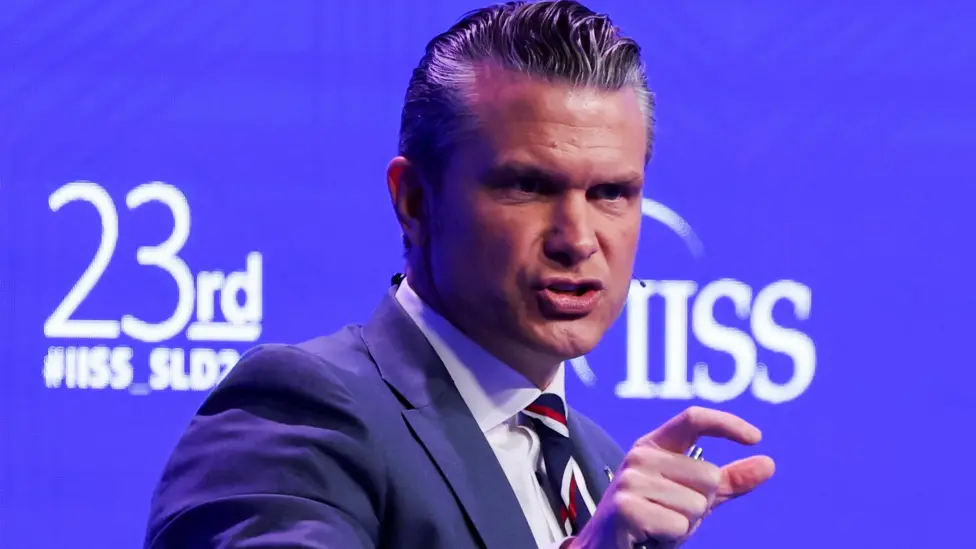
US Defence Secretary Pete Hegseth assured Asia-Pacific allies that Washington remains engaged in the region, denying any divestment of focus despite significant military commitments elsewhere, including the ongoing conflict in Iran. Speaking at the Shangri-La Dialogue in Singapore, Hegseth insisted the United States could fulfil its 'global obligations' while maintaining its strategic presence in the Pacific.
Hegseth reiterated demands for Asian partners to substantially increase their defence spending, setting an ambitious target of 3.5% of their Gross Domestic Product (GDP). He commended nations such as South Korea, Japan, Australia, and the Philippines for recent increases in military expenditure and cooperation with the US, whilst openly criticising what he termed 'freeloaders', specifically identifying New Zealand in this category.
Despite concerns from some attendees, including Japan's defence minister Shinjiro Koizumi, regarding Washington's reliability, Hegseth maintained that the US possessed a 'very strong position' in munitions stockpiles, thereby decoupling the issue of a suspended $14 billion arms package for Taiwan from broader regional commitments.
In a notable shift from previous rhetoric, Hegseth adopted a more conciliatory tone towards China, avoiding direct references to Taiwan unless prompted by questions. He acknowledged 'rightful alarm regarding China’s historic military build-up' but emphasised a US desire for a 'genuinely stable equilibrium' and a measured approach to power dynamics in the region, rather than 'needless confrontation'. This contrasts sharply with his previous year's speech, where he labelled Beijing an 'imminent threat' to Taiwan.
Hegseth dismissed 'empty globalist rhetoric about the rules-based international order', stating, 'Rules are great, but if you can’t back them up with hard power, the rules are not worth the paper they are written on.' He advocated for 'more combat power… less Shangri-La Dialogue, more ships and more subs', signalling Washington's preference for tangible military strength over diplomatic forums. His remarks followed Vietnamese President To Lam’s keynote speech, which had called for increased dialogue to resolve regional tensions.