Water Cannon Deployed as Glengormley Sees Second Night of Disorder After Belfast Stabbing
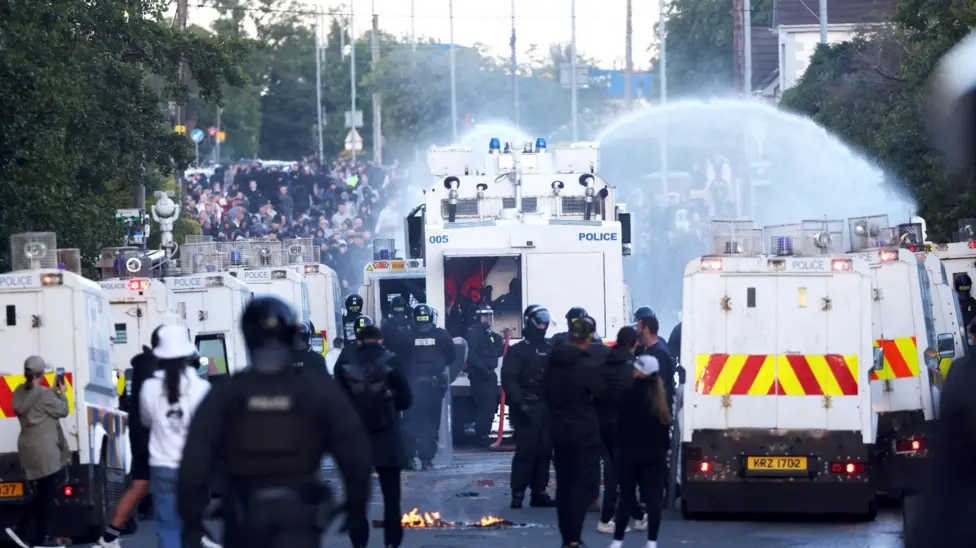
A water cannon was deployed to disperse a substantial crowd following a second consecutive night of unrest in Northern Ireland, which began after a knife attack in Belfast. Riot police were subjected to continuous assaults from a group throwing bricks, bottles, and pieces of wood at a major roundabout in Glengormley, approximately eight miles north-west of Belfast city centre.
While additional officers were mobilised, Wednesday's disorder did not reach the scale of the previous night's violence. Public transport across Northern Ireland was suspended, and some schools closed early on Wednesday, leading to a largely deserted Belfast city centre as many businesses ceased operations by lunchtime.
Footage depicted dozens of individuals, clad in black and with covered faces, dismantling driveways and fences from nearby properties to use as projectiles. A Department for Infrastructure vehicle was set alight, along with bins. The crowd attempted to set fire to a derelict property in the vicinity, with some throwing petrol bombs at police lines, apparently targeting a hotel housing asylum seekers.
Protests occurred elsewhere in Northern Ireland, though most remained peaceful. In east Belfast, a significant flashpoint on Tuesday, around 150 people gathered under a large police presence, with few arrests reported. In Coleraine, County Londonderry, over 100 protesters confronted police regarding houses of multiple occupation before dispersing. Around 140 protesters also assembled at the Stormont estate in Belfast.
Legal Proceedings and Public Reaction
Hadi Alodid, 30, from Sudan, appeared in court on Wednesday charged with attempted murder over a knife attack in north Belfast on Monday, which left Stephen Ogilvie, in his 40s, with severe injuries, including the loss of an eye and damage to the other, along with neck and back wounds. Ogilvie's family released a statement confirming his stable condition and appealing for “peaceful protest as the only way forward,” noting the valuable contributions of many migrants.
The attack and the alleged assailant's ethnicity precipitated widespread protests on Tuesday evening. Masked groups set fire to homes, a bus, and cars, primarily in Belfast, forcing families to evacuate. Petrol bombs were also directed at police in multiple locations. Other protests in areas such as Ballymena, Londonderry, and Antrim remained peaceful.
Official Condemnation and Concerns
The Stormont Executive issued a collective statement condemning the disorder, reiterating calls for calm and highlighting the significant harm, fear, and risk to innocent lives. The Royal College of Nursing reported that some staff, including overseas nurses described as “absolutely petrified,” were stopped by masked men on Tuesday night while attempting to reach work.
Prime Minister Sir Keir Starmer stated that while the Monday attack was abhorrent, the subsequent violence and arson were “totally unjustified.” Conservative leader Kemi Badenoch called the scenes “deeply disturbing,” asserting a right to anger and expectation for border security, but unequivocally condemned burning homes or attacking police. Northern Ireland Secretary Hilary Benn urged participants to consider the terror inflicted on children. PSNI Chief Constable Jon Boutcher advised against being swayed by online views from those unfamiliar with Northern Ireland.