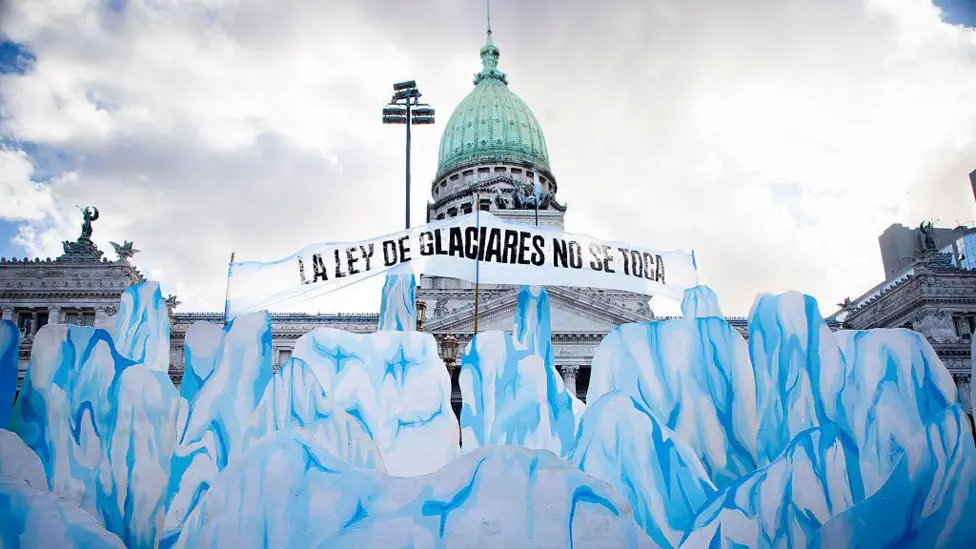
Argentina Amends Glacier Law, Sparking Environmental Concerns
Argentina's Congress has approved a controversial amendment to the nation's landmark Glacier Law, a move that environmental organisations contend significantly weakens protections for vital water resources. The original 2010 legislation had prohibited all mining and exploration activities in glacier regions, designating them as protected water reserves.
Shift in Authority and Economic Rationale
The newly approved reform reassigns the responsibility for delineating protected glacier areas from the Argentine Institute for Snow, Ice and Environmental Sciences (Ianigla) to individual provincial governments. President Javier Milei, a staunch advocate of the change, asserted that the alteration "empower[s] the provinces to utilise their resources" and permits mining where previously there were "nothing to protect." This legislative shift, already sanctioned by the Senate in February 2026, met its final hurdle in the lower house.
Environmental Safeguards Questioned
Critics, including opposition politicians, have voiced serious concerns, arguing that the reform places a fundamental resource—water—at significant risk. Congresswoman Natalia de la Sota emphasised, "Without water, we can't even think about a growth and development project." Conversely, Congresswoman Nancy Picón Martínez defended the bill, stating the mining industry was being unfairly maligned and that the revised law "protects glaciers, no matter how much some people want us to believe otherwise."
Under the amended law, glaciers and periglacial environments will remain under Ianigla's national inventory protection until provincial leaders can demonstrate they do not function as "strategic" water reserves. Argentina is home to 16,968 glaciers, which supply water to 36 river basins across 12 provinces, supporting a population of seven million. These glacial meltwaters are crucial for mitigating droughts, particularly in arid and semi-arid regions like Mendoza, which are increasingly affected by climate change.
Governors from mineral-rich provinces such as Catamarca, Jujuy, and Mendoza had lobbied for the amendment, arguing that the 2010 law impeded "promoting a sustainable economic development of the provinces and the Nation without compromising future generations." However, Greenpeace has criticised the reform's premise that not all glaciers and periglacial environments serve as strategic water reserves. Biologist Agostina Rossi Serra from Greenpeace unequivocally stated, "The primary function of all glaciers and the entire periglacial environment is to act as a freshwater reservoir," underscoring their vital role in sustaining the country's water supply, especially in water-scarce regions.