Global Mangrove Forests Expand Since 2010, Reversing Decades of Destruction
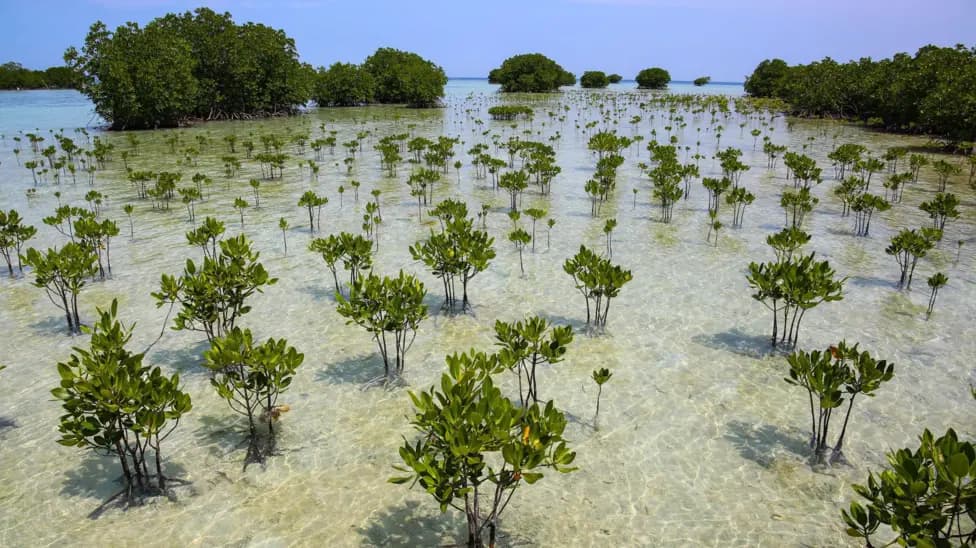
A new scientific study reveals an unexpected comeback for the world's coastal mangrove forests. These vital ecosystems, which safeguard millions from storms and absorb substantial amounts of planet-warming gases, have begun to expand, reversing a long-standing trend of rapid decline.
Decades of Depletion Reversed by Natural Regeneration
For decades, these swampy trees were systematically cleared for fish farming and housing developments. However, research indicates that since 2010, the global mangrove cover has seen more gains than losses. This positive shift is primarily driven by stronger legal protections and heightened public awareness, particularly after devastating events such as the 2004 Indian Ocean tsunami.
Scientists underscore that the primary factor in this recovery is the remarkable ability of mangroves to naturally regenerate once human interference, such as tree felling, ceases.
Ecological and Climatic Importance
Mangroves are unsung environmental heroes, storing up to five times more carbon dioxide than terrestrial forests. Their intricate root systems effectively slow wave action, shielding coastal communities from storm surges and tsunamis. Furthermore, these roots provide essential nurseries for numerous fish species and other marine life, offering protection from predators and abundant food sources.
Despite these critical benefits, mangroves faced severe threats over the last century due to the proliferation of fish farming, agriculture, and expanding coastal urbanisation. Between the 1980s and 2010, over 12,000 square kilometres of mangroves were destroyed across Asia, Africa, and the Americas—an area equivalent to Jamaica.
The new study, however, demonstrates a significant reversal. Net losses since the 1980s have been reduced to approximately 849 square kilometres. While restoration efforts contributed, the major change stems from natural mangrove expansion in many regions following reduced deforestation.
Regional Shifts and Remaining Challenges
Forest levels have stabilised in Indonesia and increased in Myanmar, two nations with extensive mangrove coverage. In Indonesia, the 2004 Indian Ocean tsunami appears to have altered public perception regarding mangrove importance, subsequently slowing their removal for fish farming. Dr Zhen Zhang from Tulane University, lead author, noted that islands protected by mangroves during the tsunami were safeguarded, significantly boosting public awareness.
A similar shift in public attitude occurred in Myanmar after Cyclone Nargis in 2008 and a national logging ban in 2016.
Technological advancements, specifically the use of more sensitive satellite imaging from Landsat, have also provided a more accurate assessment, revealing a greater extent of new growth than previous studies. Professor Elizabeth Robinson, director of the Grantham Research Institute, not involved in the study, praised this as a “considerable advance.”
However, some expanding growth may indicate other environmental issues. In countries like Brazil, new mangrove forests have thrived along nutrient-rich rivers and coastlines. This nutrient abundance, paradoxically, may result from upstream deforestation and mining flushing nitrogen into waterways.
Dr Pete Bunting from Aberystwyth University, a co-author, commented, “This is good news for mangroves—there are more of them than we thought, and they are showing their resilience. But it is only really good news if it is not a complete mess upstream.”
Despite overall success, recovery is not uniform. West and Central Africa remain hotspots of destruction. Bunting highlighted the Niger Delta as a “poster child for mangrove pollution impact,” citing massive oil pollution and visible pipeline clearings.
Tropical cyclones also pose a significant threat, responsible for some of the most dramatic single-year losses in regions from Australia to the Caribbean. Nevertheless, researchers generally view this trend as positive. Dr Zhen Zhang affirmed, “We are moving in the right direction because you can see a very clear trend of decreased loss rate.”
The study also observed that existing forests are becoming healthier, with the proportion of closed canopy mangroves, the most carbon-dense, growing by nearly 20% since the 1980s. “So, I think we are going the right way,” Zhen concluded.