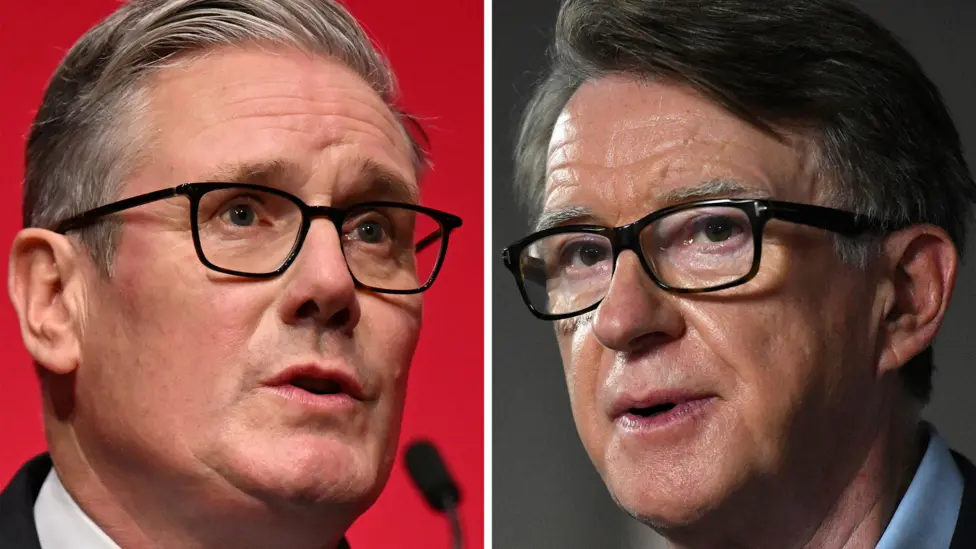
Prime Minister Faces Parliament Over Mandelson Vetting, Security Agencies Flagged Concerns in January
Prime Minister Starmer is scheduled to face parliamentary scrutiny this afternoon over the controversial appointment of Lord Mandelson as the ambassador to Washington. This follows recent disclosures that Sir Olly Robbins, the former permanent under-secretary at the Foreign Office, failed to inform the Prime Minister of security vetting concerns surrounding Lord Mandelson.
The Core Dispute: Withholding Information
The central point of contention revolves around how Sir Olly Robbins, a senior civil servant, possessed potentially politically sensitive information from security vetting and did not relay it to the Prime Minister. Questions also persist regarding the Prime Minister’s alleged lack of inquiry into the full vetting details for such a high-profile and contentious appointment.
Sir Olly arrived at the Foreign Office in January of last year, weeks after his predecessor, Sir Philip Barton, had formalised Lord Mandelson's appointment. While some vetting issues were reportedly raised with the Prime Minister prior to this, a pervasive sentiment within Whitehall suggested that security vetting did not uncover anything substantially new, and established conventions purportedly discouraged its disclosure, especially given the appointment was already a 'done deal'.
This argument is expected to form the basis of Sir Olly's defence when he appears before the Foreign Affairs Select Committee. The debate is now focusing on the precise interpretation of the Constitutional Reform and Governance Act 2010, which states that the Foreign Secretary manages the diplomatic service but that this power does not extend to national security vetting. This could be interpreted as giving Sir Olly legal cover for his discretion.
Government's Counter-Argument and Civil Service Code
However, the government published a statement asserting that nothing in the law prevents civil servants from “sensibly flagging UK Security Vetting recommendations.” They referenced the explanatory notes of the Act to bolster their position. Furthermore, the Prime Minister may cite the Civil Service Code, which mandates that civil servants must not “deceive or knowingly mislead ministers, Parliament or others” and should be aware of “the constitutional significance of Parliament” to ensure ministers do not present a misleading picture to MPs.
Reports suggest Lord Mandelson held the highest level of security clearance, 'Strap 3', during his tenure in Washington. Yet, an email sent to him in early February of last year, at the start of his role, indicated that the position “requires DV+STRAP” and that “a new STRAP application form will need to be submitted as STRAP clearance is role specific.” This instruction was issued at the commencement of his posting, not months in advance, and there is no indication that access to sensitive intelligence was restricted in his initial months.
The controversy, particularly in the lead-up to significant elections, has reignited internal frustrations within the Labour Party, with some members expressing strong disapproval of the ongoing situation. Sir Olly is reportedly considering legal action against his dismissal, which occurred despite the ambassadorship having been finalised before his arrival at the Foreign Office.