Rumen Radev's Progressive Bulgaria Party Secures Victory in Sunday's Bulgarian Election
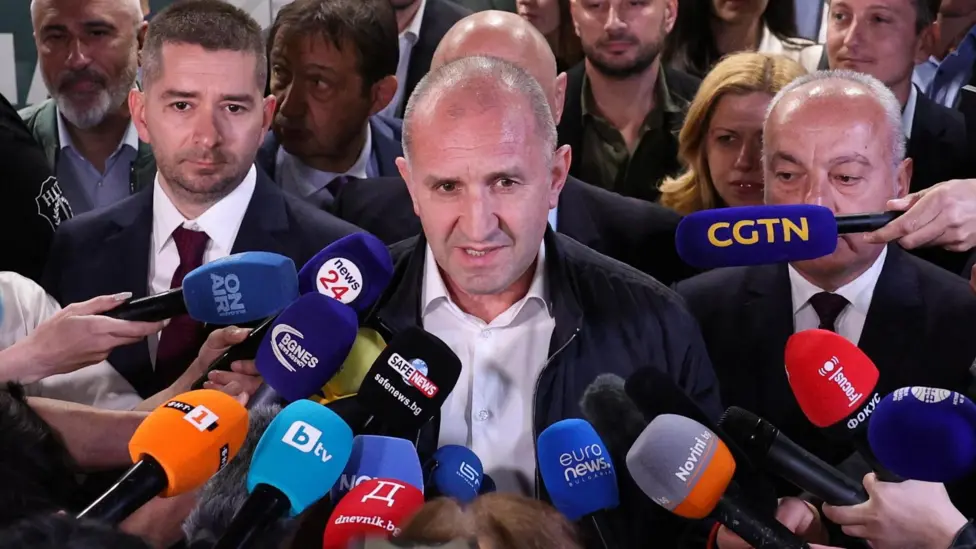
Rumen Radev's Progressive Bulgaria party achieved a decisive victory in Sunday's Bulgarian Parliamentary election, marking the country's eighth general election within five years. Exit polls indicated a 37% share for Progressive Bulgaria, significantly surpassing former prime minister Boiko Borisov's GERB party, which secured 16%.
This election followed the collapse of the previous government in December due to a contentious budget proposal, which triggered widespread protests supported by Radev during his presidency.
In his victory address, Radev stated, "People rejected the self-satisfaction and arrogance of old parties and did not fall prey to lies and manipulation. I thank them for their trust." He pledged to foster "a strong Bulgaria in a strong Europe," emphasising "critical thinking, pragmatic actions and good results" to rebuild Europe's security architecture and industrial capacity.
Radev, aged 62, is known for his pragmatic and somewhat pro-Russian stance, having openly criticised EU sanctions and called for direct engagement with the Kremlin. He maintains opposition to Bulgarian military assistance for Ukraine, arguing it prolongs a conflict Ukraine cannot win, a position echoed by Hungarian Prime Minister Viktor Orban.
Despite his anti-Ukraine military aid position, Radev took credit for inviting Armin Papperger, CEO of German arms manufacturer Rheinmetall, to Bulgaria in March 2025. This visit culminated in an announcement in October 2025 of a €1 billion joint venture between Rheinmetall and the Bulgarian VMZ factory in Sopot. This partnership aims to produce up to 100,000 155mm artillery shells annually and establish a new gunpowder factory, with Rheinmetall holding a 51% stake. This initiative is positioned as a contribution to the broader European effort to scale up military production.
While his party holds a significant lead, Progressive Bulgaria does not possess a strong enough mandate to govern independently, and Radev has initiated discussions for coalition partnerships. His likely approach as head of government is anticipated to mirror that of Slovak Prime Minister Robert Fico: critical of EU support for Ukraine, but not impeding private companies from manufacturing arms for the country.