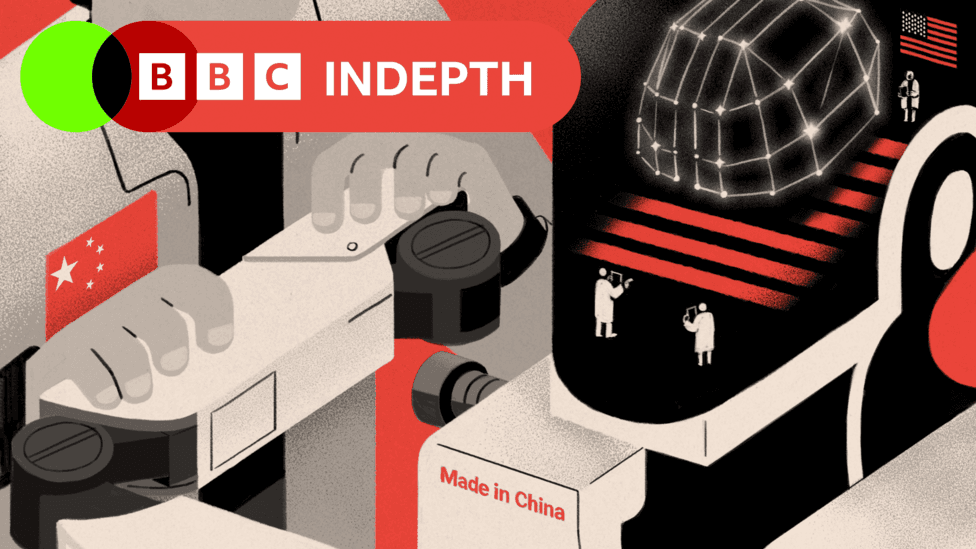
The Global AI Race: US Leads in ‘Brains,’ China Excels in ‘Bodies’ Amidst Shifting Dynamics
The 21st century's technological arms race sees the United States and China vying for supremacy in Artificial Intelligence (AI). This multi-trillion-pound endeavour spans research labs, universities, and cutting-edge start-ups, attracting global leaders from both industry and government.
US Dominance in AI ‘Brains’ Challenged
Traditionally, the US has excelled in AI 'brains,' such as chatbots and large language models (LLMs). The launch of OpenAI's ChatGPT in November 2022 marked a pivotal moment, showcasing the capabilities of LLMs to a mainstream audience. American tech giants like Anthropic and Google swiftly followed suit, investing billions to develop rival systems.
A critical element of this US advantage lies in high-end microchips, predominantly designed by California-based Nvidia, a company recently valued at £3.8 trillion. Washington employs stringent export controls, dating back to the 1950s and significantly bolstered in 2022, to prevent China from accessing these powerful chips. These controls leverage the 'foreign direct product rule,' compelling foreign manufacturers, such as Taiwan Semiconductor Manufacturing Corporation, to comply with US regulations if their products contain American parts or technology.
However, China has begun to challenge this lead. In January 2025, the launch of DeepSeek, a Chinese-developed AI chatbot, demonstrated comparable capabilities to its American counterparts at a fraction of the cost and with significantly reduced computational requirements. This development, attributed to Chinese developers being forced to innovate around chip restrictions, has been a 'hugely discombobulating' event for Washington. China's 'open source' approach, where firms often publish their codes online, further accelerates innovation and reduces development costs, making the race for AI 'brains' increasingly competitive.
China's Edge in AI ‘Bodies’ and the Integration Challenge
Conversely, China has historically held the upper hand in AI 'bodies' – the realm of drones and robotics. Substantial government investment from the 2010s has propelled China to possess an estimated two million working robots, exceeding the rest of the world combined. This success is underpinned by China's strong manufacturing economy, fostering a fertile ground for robotics start-ups. Notably, China leads in 'humanoid' robots, with examples like the 'dark factory' in Chongqing, a fully automated plant capable of producing a new car every minute, showcasing advanced integration of robotics.
China's drive for robotics is partly a response to its rapidly ageing population, with humanoids envisioned to fill labour gaps, particularly in care work. The country now accounts for 90% of all humanoid robot exports.
Yet, a significant challenge remains: while China excels in building robot bodies, these require intelligent 'brains' – advanced operating systems powered by agentic AI – to perform complex, varied tasks. The US still maintains a lead in this area, which accounts for approximately 80% of a robot's overall value.
The Future of the AI Race: Integration and Global Standards
Both nations are now racing to integrate advanced agentic AI with robotics. US firms like Boston Dynamics, with their dog-like robot Spot, are demonstrating sophisticated applications in industrial inspections. More concerningly, the combination of robotics and agentic AI is evident in battlefield drones, as seen with Ukraine's Gogol-M, capable of autonomous targeting.
The outcome of this race is far from certain. As Greg Slabaugh, Professor of Computer Vision and AI at Queen Mary University of London, notes, 'victory' will likely be a sustained advantage in capability, economic integration, and the setting of global standards, rather than a singular achievement. The differing approaches – American firms pushing innovation with minimal oversight versus China's state-controlled research – suggest distinct paths forward. Ultimately, the nation that successfully courts a wider audience of users and adopters is likely to prevail, shaping the 21st century's geopolitical landscape.