Ukraine Drone Campaign Intensifies Fuel Crisis Across Russian-Occupied Crimea, Disrupting Supply Lines
Ukraine's sustained campaign of drone attacks on Russian-occupied territories is disrupting Moscow's supply lines and intensifying a fuel crisis already triggered by long-range strikes on Russia's oil refineries. Crimea, illegally annexed by Russia in 2014, has experienced significant logistical difficulties and shortages.
Many of these issues stem from recent Ukrainian strikes on a key motorway and bridge linking the southern Russian city of Rostov to Crimea via the occupied port city of Mariupol. This route is considered the backbone of Russian occupation in the south, according to Clément Molin, an analyst at Atum Mundi. Molin stated that Ukraine has conducted 300 drone strikes on trucks, including 30 tankers, since May, with increased intensity this month.
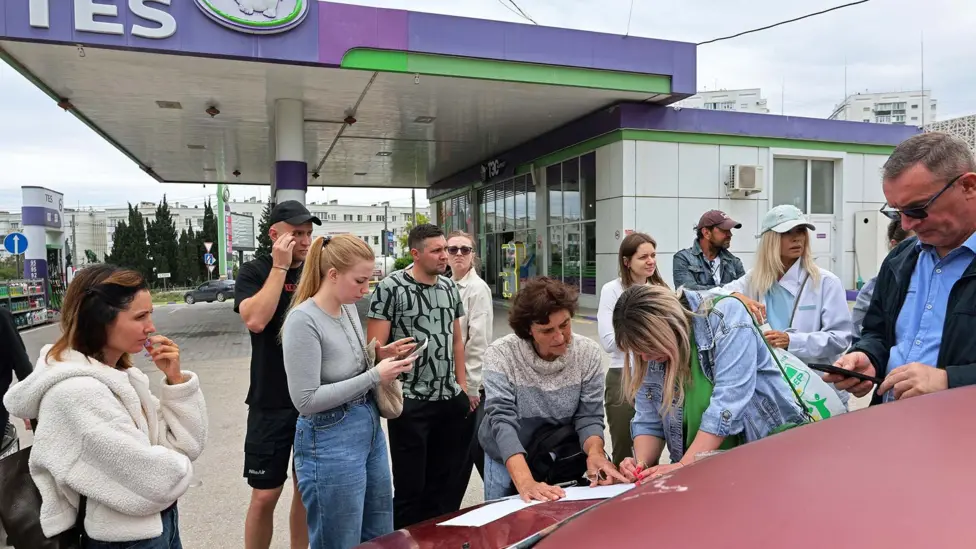
The operation has tangible effects on Crimea, a strategically important area for Moscow's military operations and a popular holiday destination for Russians. Disgruntled tourists and locals have reported extensive queues for petrol, some lasting up to 10 hours. Most Crimean petrol stations now limit purchases to 20 litres using prepaid vouchers, when fuel is available. Russian tourists are struggling to find fuel to leave, prompting Moscow-installed authorities to launch a special hotline.
Sergei Aksyonov, the Kremlin-appointed regional head, admitted on 5 June that it was not possible to fully satisfy fuel demand, leading to hundreds of buses being grounded. The sea route to Crimea is too perilous after Ukrainian actions rendered several ferries inoperable, leaving roads, vulnerable to attack, as the primary supply route.
Craig Kennedy, an expert in Russia's oil industry at Harvard University, noted the risks of transporting fuel via the Kerch Bridge, forcing reliance on land routes through Mariupol, which are exposed to Ukrainian attacks. Pro-Kremlin Russian military analysis account Rybar conceded that the logistics crisis affects both civilian and military supplies.
On 7 June, a Ukrainian strike damaged a critical bridge in Chonhar, northern Crimea, used by Russian troops and civilian vehicles on the R-280 motorway, halting traffic. These issues are compounded by Ukraine's long-range strikes against Russian oil refineries and depots, which President Volodymyr Zelensky stated disabled nearly 40% of Russia's primary oil refining capacity in May.
Kennedy observed that Ukraine is now targeting smaller, local distribution networks, leading to a more focused impact on local populations and military in regions like Crimea. Drone attacks have also affected occupied Luhansk and Kherson regions. Ukrainian drone unit commander Yevhen Karas indicated that disrupting Russian military logistics is a core priority, with targets including Russian storage, oil, and fuel tanks.
Russian claims of civilian casualties in Ukrainian attacks in occupied regions, including a recent strike on a passenger train in Crimea, have emerged. While Karas did not specifically comment on these incidents, he asserted that heavy trucks and large transport vehicles are at risk due to Russian military use, acknowledging that