Vladimir Putin Demands Ukraine Cede Donbas as Kremlin Rhetoric Shifts on Conflict Duration
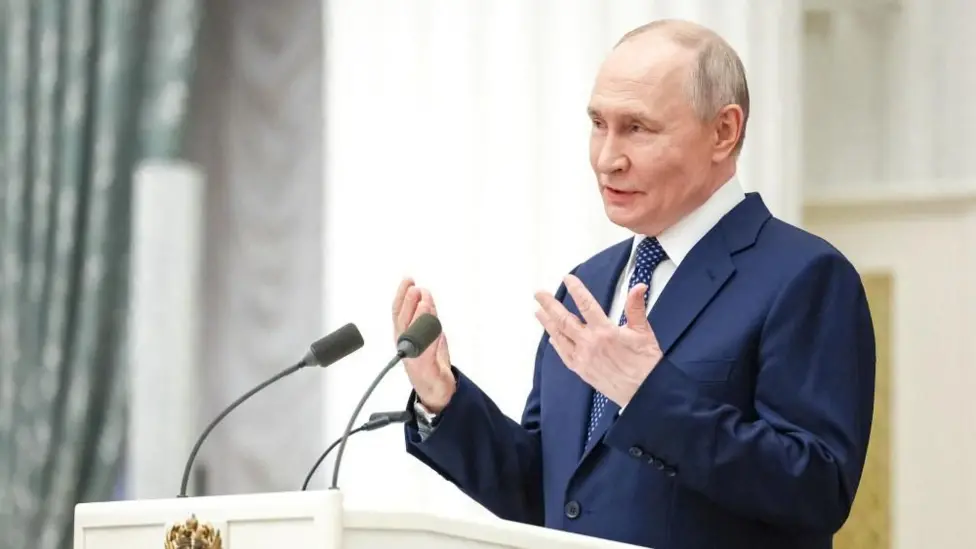
President Vladimir Putin’s public posture on the Ukraine conflict remains unwavering, with Moscow continuing its demand that Kyiv surrender control of the entire Donbas region. This steadfastness comes as Russia launched another significant missile and drone assault across Ukraine, coinciding with the St Petersburg International Economic Forum.
Kremlin’s Unyielding Stance and Shifting Expectations
The Forum, intended to showcase Russia to international investors and politicians, now primarily draws delegations from countries beyond the traditional Western sphere. This shift underscores Russia’s isolation following its 2022 invasion and the subsequent imposition of widespread international sanctions. Despite these economic pressures and the conflict entering its fifth year, Moscow continues its military operations, framing them as a necessary response.
Previously, Kremlin officials expressed confidence that former US President Donald Trump would facilitate a peace agreement favourable to Moscow, particularly after the 2025 US-Russia summit in Anchorage. However, the anticipated deal failed to materialise. Yuri Ushakov, President Putin’s foreign policy aide, recently dismissed the notion of an “Anchorage spirit
,” signalling a retreat from earlier optimism within the Kremlin regarding US intervention on Moscow’s terms.
What President Putin initially termed a “special military operation
” has become a protracted war of attrition, marked by substantial Russian casualties, economic strain, and technological setbacks. Ukrainian drone attacks now regularly penetrate deep into Russian territory, targeting critical energy infrastructure and even reaching the Moscow region, demonstrating vulnerabilities in Russian air defences. The annual Victory Day parade on Red Square was scaled back in May, reflecting heightened security concerns.
Emerging Domestic Discourse on War’s Future
Despite the official line, there are discernible shifts in the public discourse within Russia concerning the war’s continuation. Vasily Kashin, a political scientist with ties to Russia’s foreign policy establishment, recently asserted in the journal Russia In Global Affairs that achieving the goal of eliminating the “anti-Russian regime
” in Ukraine is “fundamentally unachievable
” without a complete, long-term military occupation, a scenario deemed “technically impossible
” for Russia.
Echoing this sentiment, the pro-Kremlin tabloid Moskovsky Komsomolets quoted political commentator Alexander Nosovich, who noted a split in the “expert community
” between those advocating for continued military operations and those believing it is time to end the conflict, fearing an “endless special operation
.” The same publication carried an article by lawyer Dmitry Krasnov, suggesting that, historically, Russia’s “lost wars and humiliating truces
” have often led to significant reforms and new victories. This framing, particularly in a state-controlled media landscape that often celebrates Russian military prowess, appears to hint at the possibility of a tactical disengagement without achieving initial objectives. However, attempts to revisit Krasnov’s article online later resulted in an “Error 404
,” indicating clear limits to this nascent public discussion.