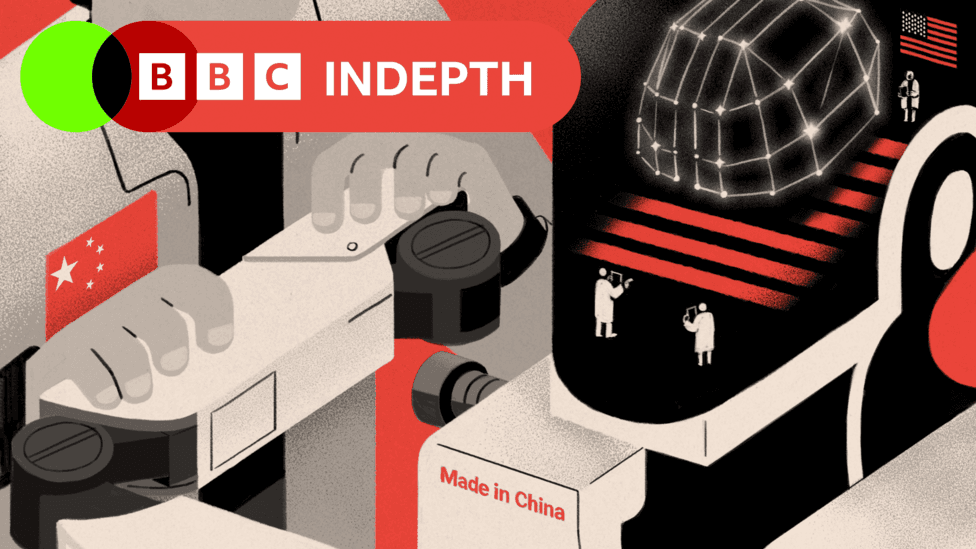
The Global AI Race: US Leads in 'Brains', China in 'Bodies' – But the Landscape is Shifting
A new global technology race is underway, with the United States and China vying for supremacy in Artificial Intelligence (AI). This high-stakes competition, reminiscent of the 20th-century nuclear arms race, involves vast investment and intense innovation across research labs and start-ups.
US Dominance in AI 'Brains' Challenged
For some time, the US has held a clear advantage in AI 'brains', specifically in areas like chatbots, microchips, and large language models (LLMs). The launch of OpenAI's ChatGPT in November 2022 marked a pivotal moment, showcasing the capabilities of mainstream LLMs that analyse vast datasets to learn expressive patterns. American firms such as Anthropic, Google, and Perplexity have since invested billions in developing rival systems, aiming to transform white-collar professions.
A critical component of this US lead has been its control over high-end microchips, particularly those designed by California-based Nvidia, which became the world's first company valued at $5tn in October 2024. Washington employs stringent export controls, dating back to the 1950s and strengthened by President Joe Biden in 2022, to prevent China from accessing these powerful chips. This strategy leverages the 'foreign direct product rule' to ensure that even chips manufactured by US allies like Taiwan Semiconductor Manufacturing Corporation do not reach China.
However, this American advantage faced a significant challenge with China's launch of its own AI-powered chatbot, DeepSeek, in January 2025. DeepSeek demonstrated similar capabilities to its American counterparts but at a fraction of the cost, raising questions about the efficacy of US export controls. Experts suggest these controls may have inadvertently spurred China's self-reliance and innovation, forcing developers to optimise models for less powerful hardware. Furthermore, China's more open-source approach to AI development, where firms share code, has fostered rapid iteration and improvement across its tech ecosystem.
China's Edge in AI 'Bodies' and Robotics
Conversely, China has historically dominated in AI 'bodies' – the realm of drones and robotics. Since the 2010s, the Chinese government has heavily subsidised and supported robot development, resulting in an estimated two million working robots in the country, more than the rest of the world combined. This success is partly attributed to China's robust manufacturing economy, which provides a strong foundation for robotics start-ups.
China has particularly excelled in humanoid robots, designed to resemble and act like people. Examples include fully automated 'dark factories' in Chongqing, capable of producing a new car every minute without human presence. Beijing views humanoids as crucial for addressing its rapidly ageing population, particularly in sectors like care work. China now accounts for 90% of all humanoid robot exports.
Despite this leadership in robot bodies, a significant dependency remains: these robots require sophisticated 'brains' – operating systems and agentic AI software – to perform complex, varied tasks. While China can build simpler robot brains for repetitive functions, the US still holds the lead in high-powered agentic AI, which enables robots to act as independent agents and tackle multi-step assignments. Approximately 80% of a robot's value lies in its brain.
The Converging Future: Combining Brains and Bodies
Both nations are now racing to combine advanced robotics with agentic AI. US firms like Boston Dynamics are already showcasing this integration with robots such as 'Spot', a dog-like machine capable of autonomous inspections and problem-solving. More unsettlingly, this convergence is also evident in battlefield drones, exemplified by Ukraine's deployment of the Gogol-M, which uses AI to independently identify and engage targets.
The ultimate 'victory' in this AI race is unlikely to be a singular event. Instead, as Professor Greg Slabaugh of Queen Mary University of London suggests, sustained advantage will be determined by who leads in capability, integrates AI most effectively across their economy, and sets global standards. The contest reflects contrasting philosophies: the US favouring rapid, unguarded innovation by private firms, and China advocating for state oversight. The outcome of this AI race could profoundly shape global power dynamics in the 21st century.