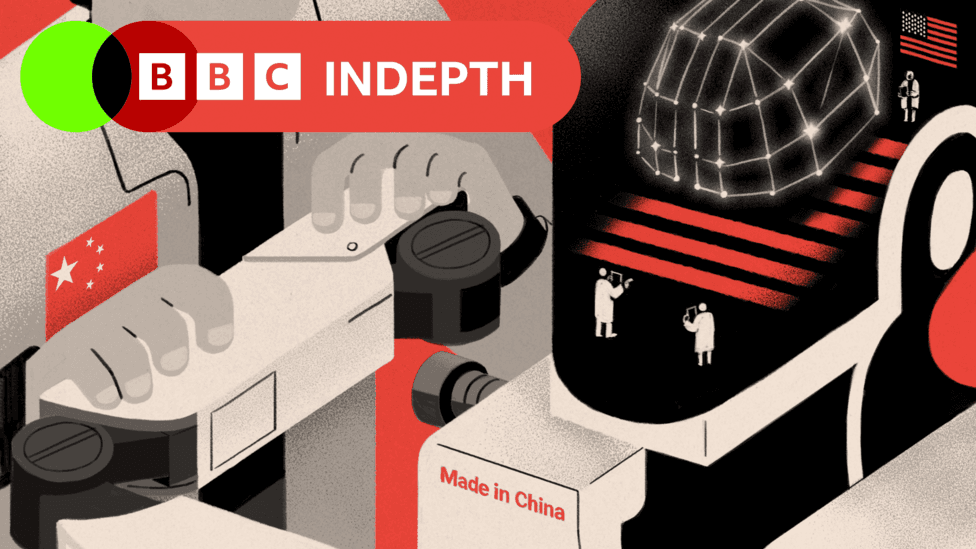
The Global AI Race: US Leads in 'Brains', China in 'Bodies' – But the Landscape is Shifting
The 21st century's defining technological contest pits the US against China in a race for Artificial Intelligence (AI) supremacy. This battle, unfolding across research labs and tech start-ups, involves trillions of US dollars and is scrutinised at the highest levels of government and industry.
US Dominance in 'AI Brains' Challenged
For some time, the US has held the upper hand in what is termed 'AI brains', encompassing chatbots, microchips, and large language models (LLMs). The launch of OpenAI's ChatGPT in November 2022 marked a significant milestone, dazzling the tech world and solidifying America's lead in developing sophisticated conversational AI.
Crucially, this advantage has been underpinned by US control over high-end microchips, particularly those designed by Nvidia. Washington has implemented stringent export controls, notably strengthened in 2022, to restrict China's access to these vital components. These controls leverage the 'foreign direct product rule', influencing manufacturing, even when chips are produced in allied nations like Taiwan, to limit their flow to China.
However, China has recently made significant strides. The launch of its AI-powered chatbot, DeepSeek, in January 2025, sent shockwaves through the industry. DeepSeek demonstrated capabilities comparable to its American counterparts but at a substantially lower computational cost. Experts suggest that US export controls may have inadvertently spurred China's self-reliance, fostering innovative, more efficient AI development.
Furthermore, China's 'open source' approach to AI development, where firms share their code, is accelerating innovation and enabling rapid iteration across its tech ecosystem. This contrasts with the proprietary models favoured by many US firms, narrowing the perceived gap in AI 'brains'.
China's Edge in 'AI Bodies'
Conversely, China has historically led in 'AI bodies' – the realm of drones and robotics. Heavily supported by government funding and subsidies since the 2010s, China now boasts an estimated two million working robots, exceeding the combined total of the rest of the world. Its manufacturing prowess has fuelled a thriving robotics sector, with humanoid robots being a particular strength.
These advancements are partly driven by China's rapidly ageing population, with humanoids envisioned to fill future workforce gaps, particularly in care. China now accounts for 90% of all humanoid robot exports.
Despite this, the sophistication of these robotic 'bodies' often relies on 'AI brains' for complex, varied tasks – specifically, agentic AI, which allows robots to act more autonomously. Here, the US retains an advantage, with companies like Boston Dynamics developing robots that integrate advanced AI for intricate operations and decision-making.
The Stakes and the Future
The convergence of robotics with agentic AI presents both exciting prospects and alarming implications, as seen in the deployment of autonomous battlefield drones. The ultimate victor in this AI race remains uncertain, with experts like Professor Greg Slabaugh of Queen Mary University of London suggesting that sustained advantage and effective integration of AI across the economy may matter more than initial breakthroughs.
The differing philosophies – US-driven consumer capitalism versus state-controlled innovation in China – will also shape the future trajectory of AI. The outcome of this technological competition could well determine which nation holds greater global power in the 21st century.